


TL;DR
- Home lifts in Dubai are becoming a practical choice for comfort, accessibility, and long-term living in multi-level homes.
- The best lift depends on layout, user needs, number of floors, and how much structural work the property can handle.
- Dubai buyers usually compare lift type, space needs, ride comfort, safety, design, and local after-sales support.
- Existing villas can often add a home lift more easily than many homeowners expect.
- A local showroom visit and real Dubai project references can make the decision much clearer.
Why does this topic matter in Dubai?
Home lifts in Dubai are no longer seen only as a luxury feature.
For many families, they are part of practical home planning. A lift can make daily movement easier, support elderly parents, reduce reliance on stairs, and help a family stay comfortable in the same home for longer. In a city where many villas and townhouses have two or three levels, that matters.
Buyers in Dubai also tend to ask sharper questions than before. They want to know what kind of lift suits an existing villa, how much space is needed, what the installation involves, and whether the supplier has real local experience. That is why this article will provide to actual homeowner questions about installing home lifts in Dubai and everything they need to know based on our knowledge and expertise.
For readers still comparing the basics, the home lift guide for UAE homeowners is a useful starting point because it explains the main lift concepts before you narrow the search to Dubai.
Why are more homeowners in Dubai considering a home lift?
In many cases, the decision starts with everyday life.
Some families are planning ahead for parents who may find stairs harder in the future. Some want smoother movement between floors now. Some are renovating an older villa and want better accessibility without changing the whole home. Others simply want a more comfortable way to use all levels of the property.
There is also a design side to the decision. In Dubai, homeowners often want a lift that feels well integrated into the house, not bulky or out of place. That is one reason why compact and design-conscious home lift solutions in the UAE are getting more attention.
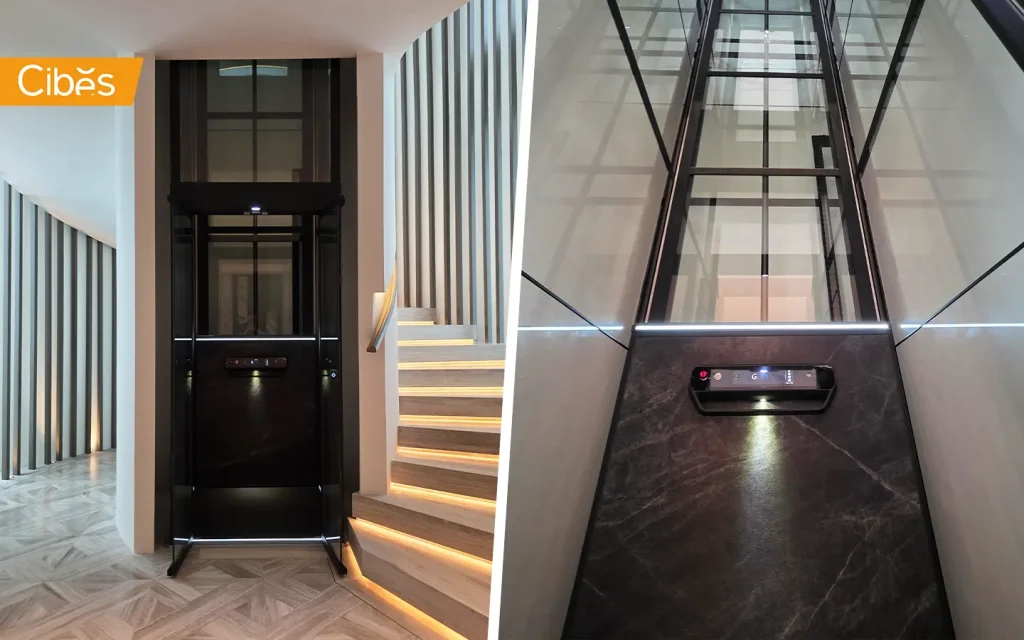
Installation of home lift V80 model in Dubai private villa, serving two floors and installed inside a round staircase.
What types of home lifts suit Dubai homes best?
There is no single best lift for every property.
The better question is this: what kind of lift fits the home, the family, and the way the space is used?
A platform lift often makes sense when the goal is easy access, efficient use of space, and a lighter installation approach. A cabin lift often appeals more to homeowners who want a more enclosed ride and a more elevator-like feel.
That comparison matters enough that buyers should review platform lift vs cabin lift for UAE homes before they decide. It helps separate what looks good in a brochure from what actually suits the property.
Technology matters too. Many buyers in this category also look closely at screw-driven home lifts because they are often associated with compact planning, quieter operation, and lower structural demands in residential settings.
How much space is needed for a home lift in Dubai?
The answer depends on the lift type, door layout, number of stops, shaft arrangement, and whether the home is new or already built. A compact lift can work well in many villas, but minimum size alone should not drive the decision. A lift that technically fits may still feel tight in daily use.
That is why size planning should look at the full picture. Door access, standing space, wheelchair use, and how the lift sits within the flow of the home all matter. For homeowners comparing tight layouts, 41 lift sizes for UAE homes and space-saving home lift solutions in the UAE can help explain what is realistically possible.
How much do home lifts in Dubai cost?
In Dubai, home lift prices can range from around AED 70,000 to AED 300,000, depending on the lift type, number of stops, travel height, finishes, and site requirements. For Cibes home lifts, typical UAE pricing is usually around AED 80,000 to AED 250,000, depending on configuration.
The final number is shaped by more than the lift itself. Model choice, number of floors, travel height, finishes, site conditions, electrical work, and any building work around the lift can all affect the real project cost.
That is why buyers should look beyond the headline price. Ask whether the quote includes delivery, installation, warranty, basic maintenance, and site coordination. Also check if civil work, power supply, slab cutting, scaffolding, or finishing work is excluded.
For a fuller breakdown, the home lift price in the UAE page is a better place to send price-focused readers than trying to force too many numbers into this Dubai guide
Can an existing villa in Dubai add a home lift?
In many cases, yes.
That is one reason the topic has become more relevant in Dubai. Many villas were never planned with a conventional elevator shaft, but the family still wants a practical vertical mobility solution. In these cases, the right lift can often be planned around the home rather than the home being rebuilt around the lift.
The best position may be beside the staircase, in a corner, against a wall, or even outside the building if indoor space is limited. The important thing is to assess the home properly before deciding.
That is why buyers comparing retrofit options should also look at the home lift installation process in the UAE and the guide to indoor vs outdoor home lift for villas in the UAE. In Dubai, outdoor placement can be useful in the right property, but climate, dust, and external detailing need more attention than many buyers first assume.

Cibes outdoor home lift installed on a modern villa exterior in Dubai with a glass shaft beside the entrance.
Which Dubai areas already have real home lift references?
A buyer does not just want polished images. A buyer wants to know whether a brand has real installations in homes and projects that feel relevant to Dubai life. On the current Cibes UAE projects page, published Dubai references include private villa installations in Mirdif, Emirates Hills, Dubai Land, and Meadows, as well as other Dubai projects such as Dubai Marina Mall and Burj Al Arab.
That does not mean a homeowner should choose a lift based on location names alone. Still, published local references help answer practical questions. Has the supplier worked in upscale villas? Has the supplier installed lifts in existing Dubai homes? Are there examples where the lift sits well within the interior rather than feeling added on?
For that reason, it makes sense to point readers to real home lift projects in Dubai and across the UAE as part of the decision journey.
Why does a Dubai showroom matter before you decide?
Because a home lift is easier to judge in person.
Photos can show design, but they cannot show ride feel, entry width, button placement, comfort, or how quiet the lift feels when it moves. A showroom visit helps buyers compare those details directly.
Cibes currently has a Dubai showroom at Office 107, Bahwan Plaza, Umm Al Sheif, SZR, Dubai, and the site positions it as the head office showroom for Dubai.
That gives this article a useful local angle. Instead of asking readers to trust product photos, it can guide them to visit the Cibes Dubai showroom and compare platform and cabin options in person before they commit.
What should buyers compare before choosing a home lift supplier in Dubai?
This is where many decisions become clearer.
The smart comparison is not just brand versus brand. It is suitability versus suitability.
A homeowner should compare:
- Lift type and whether it suits the real users
- Space planning and how comfortably it fits the home
- Ride feel and overall daily comfort
- Safety features and residential suitability
- Design and finish quality
- Installation approach and likely structural impact
- Local presence in Dubai
- Maintenance clarity after handover
- Real project references, not only studio images
This is also where Cibes can be mentioned naturally without turning the page into a sales piece. Cibes already has a Dubai showroom, a live UAE content cluster around lift planning, and published Dubai project references, which makes it easier for buyers to research the brand locally. Its main UAE guide also presents Cibes as a Swedish manufacturer with roots since 1947 and presence in around 70 countries.
That kind of local and topical depth helps a brand feel more credible in search, and it helps the page feel more useful to readers.
What a Dubai villa owner says about his Cibes home lift?
Installed in a private villa in Dubai, this project shows how a home lift can move from being a future idea to becoming part of the home’s daily routine.
Watch: Emirati homeowner testimonial video of Cibes lift in his villa in Dubai
Frequently Asked Questions (FAQs) About Home Lifts in Dubai
Are home lifts common in Dubai villas?
Yes. They are becoming more common in villas and townhouses where families want better comfort, accessibility, and long-term usability across multiple floors.
Can a home lift be added to an existing Dubai villa?
In many cases, yes. The right solution depends on the layout, available space, and how much building work the property can accept.
What is the difference between a platform lift and a cabin lift?
A platform lift is often more open and compact in feel. A cabin lift is usually more enclosed and feels closer to a conventional elevator experience.
Is indoor or outdoor installation better in Dubai?
It depends on the property. Indoor placement often feels more integrated, while outdoor placement can work well when indoor space is limited or the owner wants less disruption inside the house.
Why should a buyer visit a showroom before choosing a home lift?
Because ride quality, comfort, noise, and design feel are much easier to judge in person than online.
Are there real Cibes home lift installations in Dubai?
Yes. The published projects page includes Dubai references such as Mirdif, Emirates Hills, Dubai Land, and Khawaneej.
What should matter most when comparing suppliers?
Focus on product fit, local experience, installation approach, design quality, and how clear the after-sales support will be.
