


TL;DR:
- Modern home elevators are usually much quieter than most homeowners expect, especially when they are designed for residential use and installed properly.
- Screw-driven home lifts are often a strong choice when quiet daily use matters, because they are built for homes, not for heavy commercial traffic.
- Cibes lifts equipped with the EcoSilent drive system are listed at 40 dB, which is close to the sound level inside a quiet library.
- In real homes, lift noise depends on more than the model. Shaft quality, door alignment, vibration control, and maintenance all affect the final result.
- For homeowners who want quiet performance without major structural work, a screw-driven home lift solution in the UAE is often one of the most practical routes.
Why does lift noise matter so much in UAE homes?
Noise matters because home lifts are used in living spaces, not in commercial corridors. In a villa or townhouse, the lift may sit near bedrooms, a family lounge, a stair core, or a home office. Even a technically quiet lift can feel more noticeable if it is badly placed or poorly installed. That is why the noise question is not just about decibels. It is about how the lift behaves inside a real home.
This is also why quiet performance has become part of the wider home lift guide for UAE homeowners. Homeowners are not only comparing price or size anymore. They are comparing how the lift will feel day to day, especially in finished homes where comfort and privacy matter.
How quiet is a modern home elevator, really?
A modern residential lift should not sound like a commercial elevator. That old impression usually comes from older systems or from hearing a lift in a very different building environment.
For Cibes models equipped with EcoSilent drive, the published sound figure is 40 dB. That is presented as comparable to the sound level inside a library. Put simply, that is the kind of background sound most households can live with comfortably.
That does not mean every lift in every house will feel exactly the same. Acoustic environment still matters. Wall build-up, glazing, room echo, shaft detailing, and surrounding background sound all influence how noticeable the lift feels in practice. Even so, a 40 dB published figure gives Cibes a strong position on this topic, especially for homeowners who are actively searching for a quiet home elevator in the UAE.
Watch: Discover the Cibes EcoSilent Technology: A Quiet Revolution
Why are screw-driven home lifts often quieter in daily use?
Screw-driven lifts are often chosen for homes because they are built around residential use. They are not trying to behave like a fast commercial passenger elevator. They are made for shorter travel, regular family use, and cleaner integration into villas and townhouses.
On the Cibes UAE site, screw-driven lifts are described as smooth and quiet, with low pit and headroom requirements and easier installation in homes. The wider screw-driven guide also positions this system as safer, simpler than many traction setups, and well suited to the typical villa layout in the UAE.
That matters because quietness is not only about the sound of the motor. It is also about how much vibration travels into the structure, how much building work is needed around the lift, and how naturally the system fits into the house. In many cases, that is where screw-driven lifts do very well. For homeowners comparing systems in more detail, the page on screw-driven home lifts explains why this technology is often a better fit for villas than older hydraulic ideas or more complex alternatives.
Why does the Cibes V90 stand out on quiet performance?
Among the current Cibes range, the Cibes V90 stands out strongly for this topic. It is a cabin lift with a panoramic glass shaft, screw-driven technology, and the EcoSilent 2.0 system. The V90 is quiet, smooth, and comfortable.
That combination is important. Many homeowners want a more enclosed cabin-style lift, but they do not want the heavier feel or more demanding setup that people often associate with conventional elevator systems. The V90 answers that well. It keeps the more refined cabin experience while staying within the quieter, home-focused character of a screw-driven lift.
In simple terms, if the priority is a home lift that feels premium but still stays calm in everyday use, the V90 is one of the strongest Cibes answers to that question. It is especially relevant for homeowners already comparing platform lift vs cabin lift and trying to decide whether a more enclosed lift can still feel light, quiet, and residential.
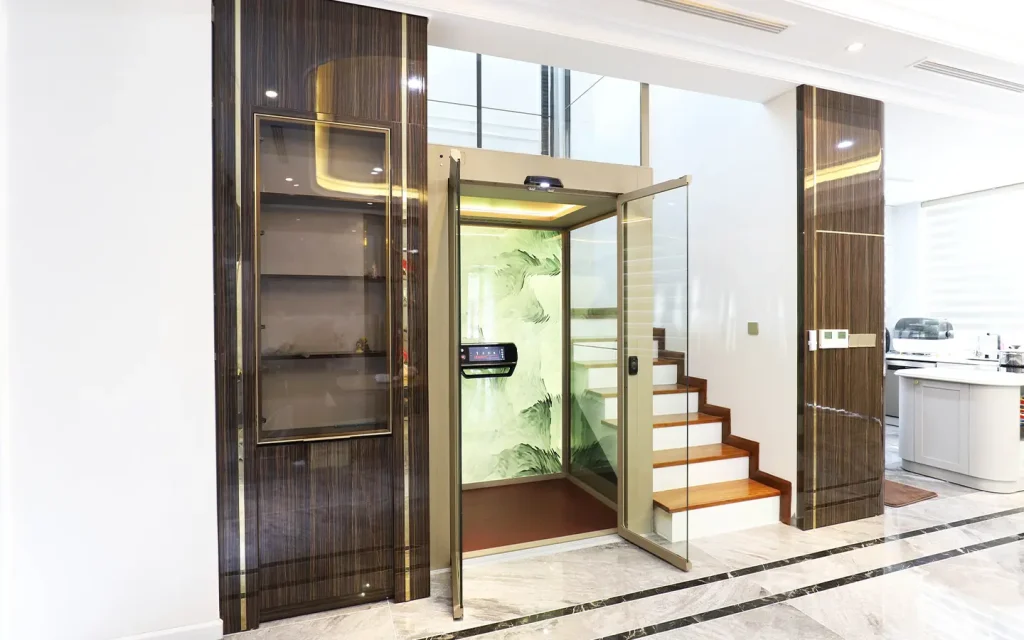
Installation of Cibes V90 cabin lift in a luxury villa serving 4 floors.
What parts of a home lift usually create noise?
In most homes, noise comes from a few familiar areas.
The motor is one source. A well-designed motor with good speed control and proper mounting will usually sound much softer than an older or poorly fitted system. The attached draft also points out that outdated or badly mounted motors tend to create more noticeable noise.
Doors are another source. If they are not adjusted properly, they can create scraping, banging, or small impact noises that feel louder than the lift travel itself. The same is true for guide rails and moving parts if installation quality is poor.
Then there is vibration transfer. Sometimes the lift is not especially loud, but the surrounding structure makes it feel louder because sound travels into nearby walls, floors, or rooms. This is one reason installation quality matters so much. A quiet lift on paper can still feel disappointing in real life if the integration into the house is careless.
Does installation affect how quiet the lift feels?
Yes. Installation can make a major difference.
The home lift installation process in the UAE makes this clear in a practical way. A proper lift project includes survey, drawings, approvals, civil preparation, assembly, testing, and handover. That process is not just about getting the lift to run. It is what helps the lift run smoothly, quietly, and reliably inside the home.
Shaft quality matters a lot here. Gaps, weak acoustic separation, poor alignment, and rushed finishing work can all make the lift more noticeable. The attached draft already touches this well, and it is worth keeping because it reflects what homeowners actually experience. Quiet operation is partly a product feature, but it is also an installation outcome.
This is also one reason screw-driven lifts tend to be easier to manage in finished villas. Because many are designed without a separate machine room and with very limited pit needs, they usually demand less intrusive structural work around the system. That often helps create a cleaner and calmer end result. The article on home lift without pit and machine room fits naturally here because reduced structural complexity often helps homeowners avoid the kinds of compromises that lead to noise issues later.
Where is lift noise most noticeable in a villa?
Noise is usually most noticeable beside bedrooms, beside home offices, and in very quiet family areas.
That matters in the UAE because many villas are lived in all day. Some households have elderly parents at home. Some have children studying. Some adults are working from home. In these situations, a quiet lift becomes more than a comfort feature. It becomes part of how well the house functions.
This is one reason quiet performance matters even more when planning a lift for multigenerational living. In that context, the article on home lift for elderly parents in the UAE is a useful internal link because the quieter and smoother the lift feels, the more comfortable daily use tends to be for older family members as well.
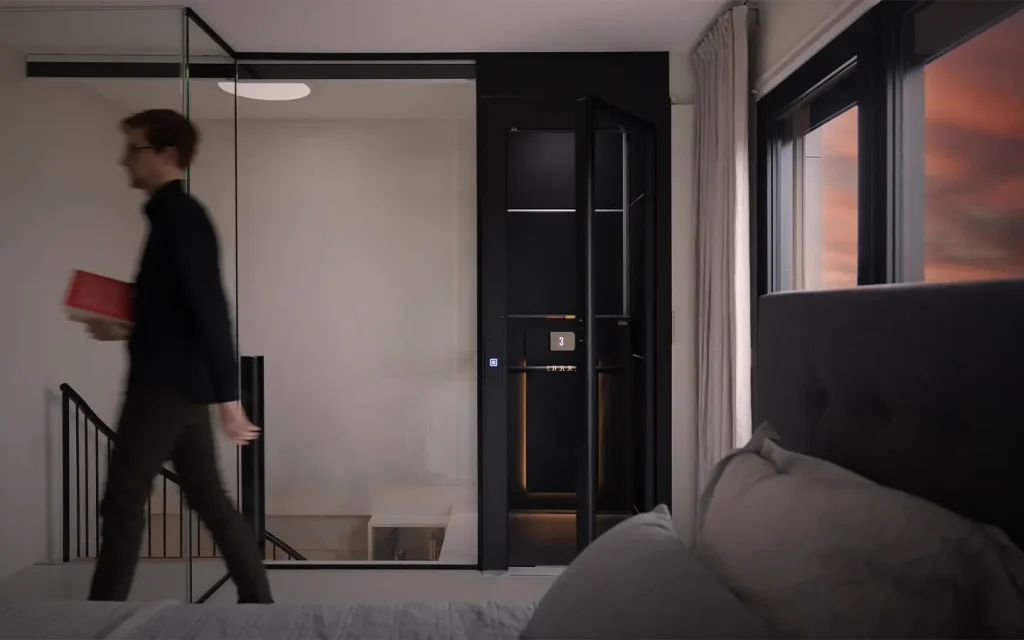
A Cibes Air home lift installed with direct access to the master’s bedroom of the house.
How can homeowners reduce home elevator noise?
The best fix is to think about noise early.
Choose a lift type that already suits residential use. In many UAE villas, that points homeowners toward screw-driven systems first. Then look at placement carefully. A small location change can make a big difference if it moves the lift away from a bedroom wall or an echo-prone room.
After that, focus on good shaft detailing, proper door setup, correct rail mounting, and regular maintenance. These are the small things that usually separate a lift that feels refined from one that feels slightly disruptive.
It also helps to compare the lift in the full context of the project. Size, shaft type, installation method, and model choice all affect the result. That is why pages like the home lift size guide in the UAE, home lift price in the UAE, and EN 81-41 safety guide naturally support this topic. Homeowners rarely ask only one question. They ask how quiet the lift is, how much space it needs, what it costs, and whether it feels safe enough for long-term daily use.
Consclusion: Are home elevators noisy or not?
Most modern home elevators are not noisy in the way people fear. The better answer is this: a good residential lift should be audible, but not intrusive.
That is where Cibes has a strong position. The combination of screw-driven technology, home-focused design, and EcoSilent-equipped models makes the quietness story much easier to support with real product detail. And within that story, the V90 is one of the clearest examples. It delivers the more premium cabin-style feel many homeowners want, while still keeping the quiet, smooth character that suits villa living.


Frequently Asked Questions (FAQs) About How Quiet Are Home Elevators
How quiet is a Cibes home lift?
Cibes lifts equipped with EcoSilent drive are published at 40 dB, which is comparable to the sound level inside a quiet library.
Are screw-driven home lifts quieter than older hydraulic lifts?
In many residential cases, yes. Screw-driven systems are built for home use and are often described as smoother and quieter, while older hydraulic systems are more often associated with the “noisy lift” impression many homeowners still have.
Is the Cibes V90 a quiet home lift?
Yes. The V90 is described as a quiet and smooth cabin lift and includes screw-driven technology with EcoSilent 2.0.
Can lift installation make a quiet model sound louder?
Yes. Poor shaft detailing, bad door alignment, vibration transfer, and weak finishing can all make a lift feel louder than it should.
Do home lifts need a machine room to run quietly?
No. Many screw-driven home lifts are designed without a separate machine room, which helps simplify installation in finished villas.
Does a quiet lift also mean low maintenance?
Not automatically, but the two often go together when the system is well designed and properly maintained. Cibes presents screw-driven lifts as smooth, quiet, and low maintenance for residential use.
