

TL;DR:
- A platform lift is usually the better fit when accessibility, wheelchair use, and lower structural impact are the main priorities in a UAE villa or townhouse.
- A cabin lift is usually the better fit when the goal is a more enclosed, elevator-like ride with more privacy, a stronger design statement, and features such as automatic operation or sliding doors.
- In many UAE homes, both categories can be space-saving because modern Cibes lifts are machine-room-less and designed for lower pit and headroom requirements than traditional elevators.
- The right answer is rarely just about lift type. It usually comes down to layout, user needs, door configuration, and how the lift will be used every day.
- For homeowners comparing a home lift solution in the UAE, the clearest route is to compare platform lift and cabin lift use cases side by side, not just compare labels.
Why does this choice matter in a UAE home?
For many UAE homeowners, a lift is no longer only about moving between floors. It is about daily comfort, future planning, easier movement for parents or family members, and finding a lift that fits a villa or townhouse without turning the project into heavy construction work. That is one reason compact modular lift systems have become more relevant in Dubai, Abu Dhabi, and other parts of the UAE.
A common problem is that “platform lift,” “cabin lift,” and “home elevator” often get used as if they mean the same thing. They do not. They overlap in some projects, but they are not identical in structure, feel, safety framework, or planning logic.
For homeowners researching a home lift solution in the UAE, this guide explains the practical difference between lift technologies where each type usually fits best, and what to check before deciding.
What is the main difference between a platform lift and a cabin lift?
A platform lift is usually the more accessibility-led category. Cibes platform lifts are presented as space-saving vertical lifts for homes and buildings, with lower structural demands, no separate machine room, and compact installation logic. EN 81-41 is commonly associated with vertical lifting platforms in this category, especially where the main use case is step-free access for people with reduced mobility.
A cabin lift is the more elevator-like category. Cibes cabin lifts are positioned as enclosed home lift solutions that offer more of a traditional elevator experience, while still using compact, machine-room-less concepts compared with conventional elevators. Cibes V90, V70, Ascenda, and Gravital all sit in this direction, though each model has a different space and design profile.
In simple terms, a platform lift usually leans more toward accessibility, openness, and lower building impact. A cabin lift usually leans more toward enclosure, privacy, and a more classic home elevator feel.
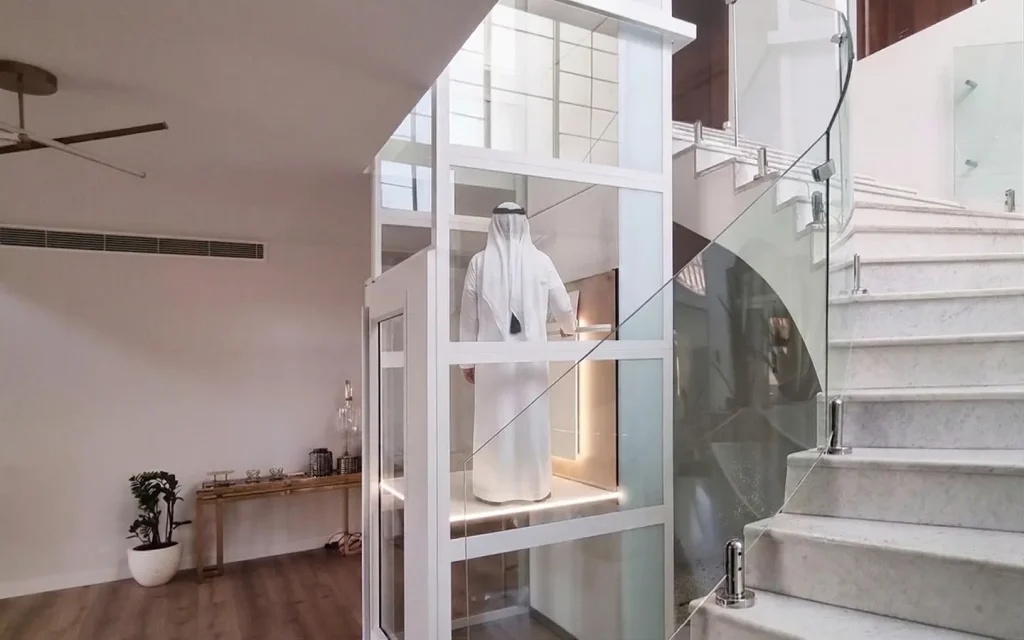
A homeowner riding his Cibes Air platform lift installed in a villa in Dubai.
How do platform lifts and cabin lifts compare at a glance?
The table below simplifies the main difference between the two categories based on current Cibes UAE product pages, the EN 81-41 guide, and model information available across the Cibes range.
| Comparison point | Platform lift | Cabin lift | What it usually means for a UAE home |
|---|---|---|---|
| Primary use case | Accessibility, step-free movement, lower structural impact | More enclosed home elevator experience | Platform lifts often suit access-led retrofits. Cabin lifts often suit comfort-led daily use. |
| Ride feel | More open and lighter visually | More private and enclosed | This often shapes the decision as much as technical specs. |
| Typical safety route | Often linked to EN 81-41 | Depends on model (Also linked to EN 81-41 and EN 81-20) | Platform lifts need the standards discussion early, especially for accessibility-led projects. |
| Space planning | Very strong for compact retrofit layouts | Still compact, but depends more on cabin and door setup | Both can work in villas and townhouses with limited space. |
| Door style | Often swing or saloon doors, half-gate is also an option | Can use swing, saloon, or sliding doors depending on model | Door choice can affect how easily the lift fits into tight layouts. |
| Speed context | Often up to 0.15 m/s | Can be 0.15 m/s or up to 0.25 m/s on some models | For a two or three stop home, comfort usually matters more than raw speed. |
| Cibes examples | V80, Air, Air 2, Voyager | V90, V70, Gravital, Ascenda | The better category depends on the property, not just the model name. |
Which lift type works best for most UAE villas and townhouses?
For many villas and townhouses in the UAE, the strongest all-round answer is often a compact screw-driven home lift with a modular shaft and no separate machine room. That is true for both platform lift and cabin lift concepts. In retrofit homes, this matters because the drive system is inside the shaft, pit requirements are lower, and the lift can often be added with less structural disruption than a conventional elevator.
That said, “best for most homes” does not mean “best for every home.” If the property is tight and the priority is step-free access with minimal building work, a platform lift often moves ahead. If the goal is a more enclosed home elevator feel with stronger visual integration into the interior, a cabin lift often makes more sense.
This is where the comparison should stay practical. The right lift is usually the one that fits the home, the landing space, the user, and the long-term plan for the property.
When is a platform lift the better choice?
A platform lift is often the better choice when accessibility is the first reason for adding a lift. That may mean wheelchair use, ageing parents, reduced mobility, recovery after surgery, or simply wanting to remove stairs as a daily barrier inside the home. EN 81-41 is commonly used as the reference point here because it applies to vertical lifting platforms intended mainly for persons with impaired mobility.
A platform lift also tends to make sense when the goal is to keep the project lighter from a civil-works point of view. Current Cibes UAE platform lift information highlights no separate machine room, low 5 cm pit or no pit at all, and top-floor headroom of about 2.3 to 2.5 m. That is a strong fit for many retrofit villas and townhouses where every structural change matters.
Models such as the V80, Air, Air 2, and Voyager also lean into a more open and panoramic design language, which many homeowners prefer when the lift is placed in a visible part of the house.
When is a cabin lift the better choice?
A cabin lift is often the better choice when the homeowner wants the lift to feel closer to a true private elevator. That usually means a more enclosed ride, more privacy, a stronger architectural statement, and in some models, features such as automatic drive and automatic sliding doors.
Cibes cabin lifts are also relevant when the property already has a prepared shaft, or when the project calls for a more defined lift car rather than an open platform concept. The V70 is positioned for existing shafts, while the V90 is presented as a panoramic cabin lift. Ascenda targets compact two-storey homes, and Gravital sits in the cabin category with automatic sliding doors.
In short, cabin lifts tend to suit homes where comfort, privacy, and elevator feel carry more weight than an accessibility-first platform format.
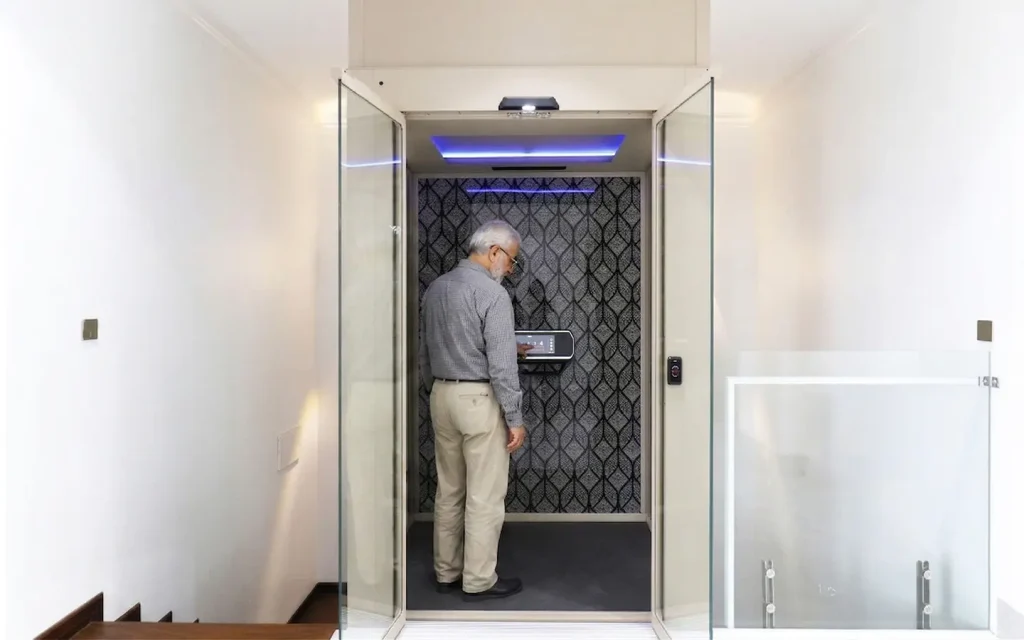
A villa owner inside his Cibes V90 home elevator. Featuring premium design and smart touch controls.
Which one takes less space?
In many UAE projects, both lift categories can be space-saving compared with traditional elevators. Cibes platform lifts are built around no separate machine room, low pit requirements, and lower top-floor headroom. Cibes cabin lifts such as the V70 and V90 are also machine-room-less and are listed with a 100 mm pit and 2500 mm headroom, which is still compact by residential elevator standards.
So the space question is not only about whether the lift is a platform or a cabin. It is also about shaft size, usable internal space, landing depth, travel height, and especially door setup. That is one reason a home lift size guide is useful early in planning.
For cabin lifts specifically, Cibes also offers different door approaches. The V-Series brochure shows swing or saloon door configurations for V80, V90, and V70, while the Gravital uses automatic telescopic sliding doors. In practice, that gives more flexibility when the goal is to keep the cabin lift concept simpler and, in some layouts, more compact than a sliding-door setup. That last point is a planning inference based on the different door systems, not a fixed rule for every project.
So which one takes less space? In many retrofit homes, platform lifts still have the edge. But a compact cabin lift with the right shaft and door setup can also work very well in a tight UAE property.
Which type is better for elderly users or wheelchair access?
For accessibility-led planning, platform lifts usually have the clearest starting point. EN 81-41 is directly tied to vertical lifting platforms used by people with reduced mobility, and that makes platform lifts especially relevant when wheelchair access or ageing-in-place is the main driver.
That does not mean a cabin lift is the wrong answer for elderly users. Some families prefer an enclosed cabin because it feels more familiar, more private, and easier for daily use by multiple people in the home. In those cases, clear cabin size, landing space, and door approach matter more than the category name alone. Cibes cabin lift models also follow the EN 81-41 safety standards, particularly those with speed of 0.15 m/s.
A good safety conversation should also include the exact model standard, door protection, alarm features, emergency lowering, and how the user will approach and exit the lift at each level. A plain-language EN 81-41 safety guide helps keep that comparison factual.
What about speed, comfort, and day-to-day feel?
Platform lifts commonly sit at up to 0.15 m/s under the EN 81-41 context. Some cabin lift configurations can go higher, and current Cibes V90 information lists 0.15 m/s with 1-phase and up to 0.25 m/s with 3-phase.
In real homes, though, speed is rarely the only issue. In a two or three stop villa, most families care more about ride comfort, easy entry, and whether the lift feels right in the home. Platform lifts often feel more open and lighter visually. Cabin lifts often feel more private and more like a classic elevator.
That difference in feel matters. A lift becomes part of daily living, not just part of the floor plan.
How much does the choice affect price in the UAE?
The choice affects price, but not as simply as many people expect. Current Cibes UAE pricing guidance places most home lift projects in the AED 80,000 to AED 250,000 range, depending on stops, travel height, size, model, finishes, and site conditions. That applies across the wider home lift conversation, including both platform and cabin-oriented solutions.
That means the better buying question is not only “which type is cheaper?” A more useful question is whether the chosen lift gives the right experience, right fit, and right level of civil work for the home. In some projects, a platform lift keeps the structure simpler. In others, a compact cabin lift creates better long-term value because the family prefers the enclosed experience.
For budgeting, the clearest next reference is a detailed home lift price in UAE guide.
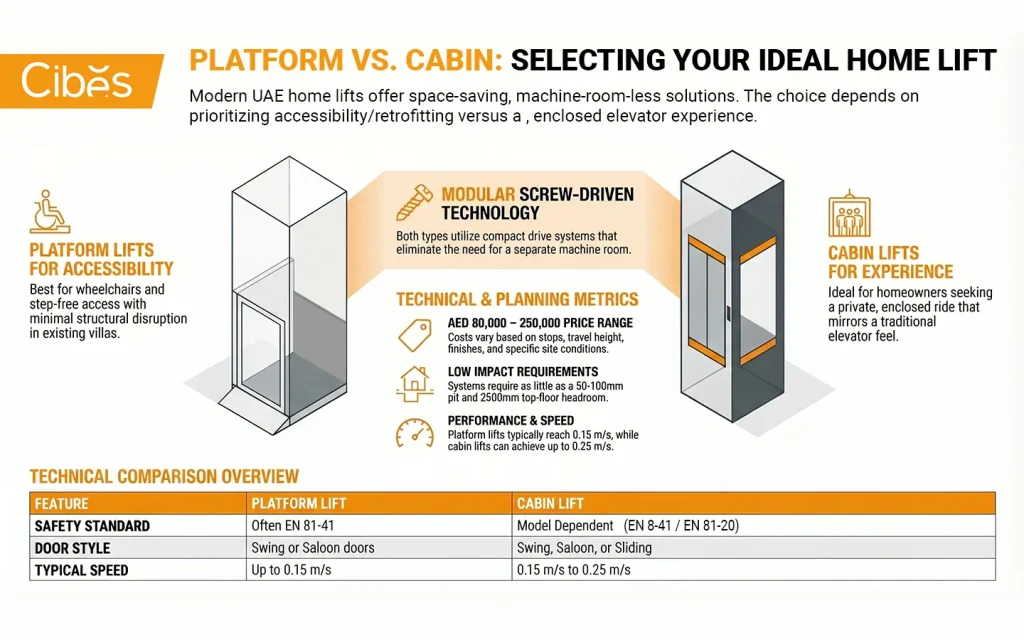
Infographics: Platform lift vs. cabin lift – Selecting your ideal home lift for UAE villas, townhouse, or penthouse.
So, which is right for your UAE home?
Choose a platform lift when accessibility, low structural impact, and compact retrofit planning are the main priorities. That is often the cleaner answer for wheelchair access, elderly use, and existing homes where space is tight.
Choose a cabin lift when privacy, enclosure, and a more traditional home elevator feel matter more. That is often the stronger fit for homeowners who want the lift to feel fully integrated into the interior, not only added for access.
In both cases, the real answer depends on the user, the door layout, the shaft plan, and the daily use pattern. For most UAE homes, the best decision comes from comparing the use case first, then the model.
Frequently Asked Questions (FAQs) About Platform Vs Cabin Lifts
What is the difference between a platform lift and a cabin lift?
A platform lift is usually more accessibility-led and more closely linked to EN 81-41. A cabin lift is more enclosed and closer to a traditional home elevator feel.
Which is better for a villa in the UAE?
For many villas, a screw-driven modular lift concept works well. Platform lifts often suit tighter retrofits and accessibility needs, while cabin lifts often suit comfort-led daily use.
Do cabin lifts always need more space than platform lifts?
No. Cabin lifts can still be compact. Cibes V70 and V90 are both machine-room-less and use relatively low pit and headroom requirements for residential use.
Are platform lifts slower than cabin lifts?
Often, yes. Platform lifts commonly sit at up to 0.15 m/s, while some cabin lift setups can reach 0.25 m/s depending on model and power setup.
Which type is better for elderly parents?
A platform lift is often the first option for accessibility-led use, but some families prefer a cabin lift because it feels more enclosed, familiar, and comfortable for everyday use.
Can a cabin lift use different door types?
Yes. Within the Cibes range, some cabin-related V-Series configurations are shown with swing or saloon doors, while Gravital uses automatic sliding doors.
Does price depend more on lift type or project details?
Project details matter more. Stops, travel height, size, finishes, site readiness, and structural work all affect the total price.
