

TL;DR:
- All home lifts are safe, but they are built differently
- Hydraulic lifts are older and less common in UAE homes today
- Traction lifts suit large villas with many floors
- Screw-driven lifts suit most UAE homes due to space and ease of installation
- The right choice depends on your home layout, not just the lift type
Is Lift Type Matters for your Home?
If you search for home lifts online, you quickly run into confusing terms. Most homeowners are not engineers, and they should not need to be. In the UAE, many villas and townhouses were not originally designed for lifts. That makes the type of lift system even more important.
This guide explains each system in a simple way, so you can understand what fits your home without guessing or relying on sales talk.
What is a hydraulic home lift?
How hydraulic lifts work:
- A hydraulic lift works using oil pressure.
- When oil is pushed into a cylinder, it lifts the cabin upward.
- To make this work, the system usually needs a deep hole under the lift and a separate room for the machinery.
- This design comes from older building methods and was once very common.
Advantages:
- Hydraulic lifts are strong and stable. They have been used for many years and are well understood.
- They can handle heavy loads and move smoothly between floors. That is why they are still used in some commercial buildings.
Limitations in UAE homes:
- For most UAE villas, hydraulic lifts create practical issues.
- Hydraulic lifts need a deep pit, which means breaking floors and concrete. They also need a machine room, which takes away usable space.
- Because they use oil, they need more maintenance, especially in hot weather. For these reasons, hydraulic lifts are now rarely chosen for private homes in Dubai and Abu Dhabi.
What is a traction home lift?
How traction lifts work:
- Traction lifts move using steel cables or belts and a counterweight. The motor pulls the lift up while the counterweight helps balance the load.
- Think of it like a very advanced pulley system. Most modern traction lifts no longer need a separate machine room.
Advantages:
- Traction lifts offer a very smooth ride. They are also energy-efficient when moving up and down.
- They are well suited for taller buildings with more floors. That is why they are often used in apartments and large villas.
Limitations in UAE villas:
- Traction lifts usually need more space above the lift for equipment. This overhead space is not always available in existing homes.
- They are also more complex to install, especially in houses that are already built. For a typical two or three floor villa, their extra performance often goes unused.
What is a screw-driven home lift?
How screw-driven lifts work:
- A screw-driven lift uses a strong vertical steel screw that is locked in place.
- A nut is attached to the screw, and as the motor rotate the nut, it will move up or down along with the cabin.
- There are no cables, no oil, and no counterweights. The system moves slowly and steadily, which makes it very controlled.
Why screw-driven systems suit UAE homes (Advantages):
- Screw-driven lifts are designed mainly for homes, not large buildings. They do not need a deep pit or a machine room.
- This makes them ideal for villas that were not built with lifts in mind. Installation usually involves far less construction work.
Limitations to consider:
- The speed of a screw-driven lift is not quite fast compared to hydraulic or traction lifts. For safety reasons, it is limited to 0.15 m/s in compliance to European Safety Standards.
- Screw-driven lifts are designed for residential use, so their weight capacity is typically a bit lower than hydraulic or traction systems.
Safety and comfort:
- One key feature is that the cabin cannot fall. If power stops, the lift simply stays where it is.
- The movement is quiet and vibration is minimal. For daily use in a family home, this creates a calm and comfortable experience.
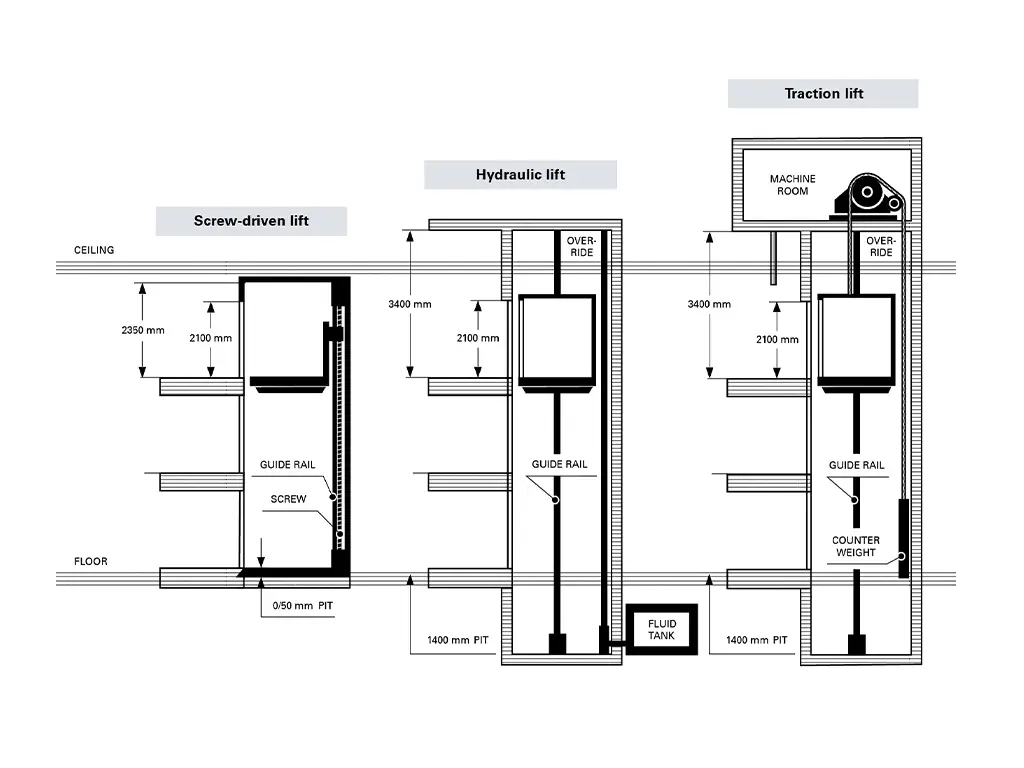
This comparison shows how screw-driven lifts require minimal pit and headroom, while hydraulic and traction lifts need deeper pits, extra overhead, and more structural space.
Lift systems side-by-side comparison for UAE homes
| Feature | Hydraulic | Traction | Screw-Driven |
|---|---|---|---|
| Needs deep pit | Yes | Yes | No or very shallow |
| Needs machine room | Yes | Usually | No |
| Best for floors | 2–3 | 4 or more | 2–4 |
| Noise level | High | Low | Very low |
| Maintenance effort | High | Medium | Low |
| Works well in heat | Moderate | Good | Very good |
| Common in UAE homes | Rare | Sometimes | Very common |
Which home lift system should you choose?
Choose screw-driven if:
- Your home has two or three floors.
- You want minimal building work and less disruption.
- You care about quiet operation and long-term reliability.
- This is the most common situation for UAE homeowners.
Choose traction if:
- Your villa has four or more floors.
- You want faster travel and have enough space.
- This is usually planned during construction, not after.
- It also requires a higher budget.
Consider hydraulic only if:
- Your home already has the right structure.
- The installer has a clear technical reason.
- For most modern villas, this option is rarely practical.


Frequently Asked Questions (FAQs) for Lift Type Systems
Q: Which home lift type is most popular in UAE villas?
A: Screw-driven lifts are the most popular because they fit easily into existing homes and require less construction work.
Q: Why do many homeowners avoid hydraulic lifts?
A: They need deep pits, oil systems, and more maintenance. These factors do not suit most private homes.
Q: Are traction lifts better than screw-driven lifts?
A: They are better for tall buildings. For normal villas, the difference is rarely noticeable in daily use.
Q: Which lift is safest for children and elderly users?
A: Screw-driven lifts are considered very safe because the cabin cannot fall even during a power cut.
Q: Which lift has the lowest running cost?
A: Screw-driven lifts usually cost less to maintain over time because they have fewer parts and no oil.
