TL;DR:
- Villas usually allow more freedom for indoor, outdoor, and stairwell lift installation.
- Apartments and penthouses need closer review because they sit inside shared buildings.
- Screw-driven home lifts are useful where space, pit depth, and machine room limits matter.
- Modular Cibes lifts are delivered in parts and assembled on site, which helps in high-rise homes.
- The right lift depends on structure, travel height, approvals, access route, and daily use.
Why does home type matter when choosing a lift in the UAE?
A home lift is not planned the same way for every property.
A villa in Meadows, a penthouse in Al Maryah Island, and a luxury apartment in JBR may all need a private lift. But each one has different rules, space limits, and installation challenges.
In a villa, the homeowner usually has more control. The lift can be placed near the staircase, in a corner, through a floor opening, or outside the villa.
In an apartment or penthouse, the lift must fit inside a shared building. That means more checks with building management, consultants, and sometimes authority approvals.
This guide explains the main differences between home lift solution in villa, apartment, and penthouse in the UAE. It also explains why modular screw-driven lifts, such as Cibes home lifts, can be a practical choice for finished homes and high-rise properties.
Why does home type matter when choosing a lift in the UAE?
In a villa, the owner usually controls the full property. There may still be community rules and local approval steps, but the planning is often more flexible.
In an apartment or penthouse, the owner controls the unit, not the full building. The lift must not affect common areas, fire escape routes, structural slabs, shared services, or the building façade.
| Property type | Main concern | Common lift approach |
|---|---|---|
| Villa | Space, structure, and design | Indoor, outdoor, stairwell, or through-floor lift |
| Apartment | Building rules and limited space | Compact lift inside a duplex or multi-level unit |
| Penthouse | Access, structure, and interior finish | Modular lift assembled on site with careful planning |
For homeowners, the simple question is: where can the lift go without making the home harder to use?
For architects, the question is wider: how can the lift work with the structure, approvals, fire safety, and interior design?
Why are villas usually easier for home lift installation?
Villas are often easier because there are more possible lift locations.
Many UAE villas have stair halls, side setbacks, double-height areas, wide landings, or outdoor walls that can be reviewed for lift placement.
Cibes home lift installations in villa communities such as Meadows, Palm Jumeirah, and Mirdif show common reasons why UAE homeowners add a lift. Some want better access for elderly parents. Some want to future-proof the home. Others want easier movement between floors for daily life.
Where can a lift be installed in a villa?
A villa lift can often be installed in one of these locations:
| Villa lift location | When it works well | What to check |
|---|---|---|
| Beside the staircase | When the stair hall has enough space | Door swing and walking path |
| Through a floor opening | When floors can be connected vertically | Structural support and finishing |
| In an unused corner | When there is a compact void | Shaft size and headroom |
| Outside the villa | When indoor space is limited | Weather protection and façade approval |
An outdoor villa lift can work well when the home has limited indoor space. It can connect the garden, ground floor, first floor, or roof terrace, depending on the layout.
For outdoor installation in the UAE, the lift needs proper planning for heat, dust, humidity, rainwater, and access protection.

A Cibes home lift installed outdoor of a villa located in Meydan, Dubai.
Why are apartments more complex for private lifts?
Apartments are more complex because they are part of a shared building.
A private lift cannot be planned only around the unit layout. It also has to respect the building structure, fire strategy, shared services, and management rules.
In most cases, a private lift inside an apartment only makes sense when the unit has more than one level. This includes duplex apartments, triplex apartments, and some large luxury residences.
A standard single-floor apartment usually does not need a private lift because there is no internal level change.
For multi-level apartments, the main checks are:
- Is there enough space inside the unit?
- Can the floor opening be approved?
- Will the lift affect any structural element?
- Can lift parts be delivered to the unit?
- Will the lift affect fire safety or escape routes?
- Does building management allow this type of work?
This is why apartment lift projects need early coordination. The lift supplier, architect, structural engineer, and building management should all be involved before the final location is chosen.
Why are penthouse lifts different from apartment lifts?
Penthouses often have more space than regular apartments, but they still sit inside a larger building.
That makes them a special case.
A penthouse lift may connect a living floor to a private roof, terrace, bedroom level, or entertainment area. It may also support aging in place for homeowners who want long-term comfort without moving to another property later.
Cibes has references in high-end UAE properties such as Al Maryah Island in Abu Dhabi, Burj Al Arab in Dubai, and JBR. These types of projects show why penthouse lift planning needs extra care.
The lift must fit the structure, but it also has to respect the interior finish. In luxury homes, the lift should feel planned from the start, not added as an afterthought.
What should be checked for a penthouse lift?
A penthouse lift needs a careful site review. The team should check:
- Floor-to-floor height
- Roof or terrace access
- Slab opening position
- Service lift size
- Delivery route from loading bay to unit
- Building work permit rules
- Fire safety requirements
- Noise and vibration control
- Final finishes around the lift
Delivery access is one of the biggest issues. Some lift parts may need to pass through a service lift, corridor, lobby, or private entrance. If this is not checked early, the project can face delays.
Why is modular lift design useful for apartments and penthouses?
A modular lift is made from parts that are delivered separately and assembled on site.
This matters a lot in UAE apartments and penthouses.
A fully built lift structure cannot usually be brought into a high-rise building. Corridors may be narrow. Service lifts may be small. Delivery hours may be restricted. Finished interiors must also be protected.
Cibes lifts are built around a modular concept. The lift parts are delivered to the property and assembled at the site. This can make installation more practical in duplex apartments, triplex units, and penthouses.
| Site challenge | How modular design helps |
|---|---|
| Small service lift | Parts can be moved in smaller sections |
| Tight corridors | Components can be planned around access limits |
| Finished interiors | Less heavy work inside the unit |
| High-rise delivery rules | Easier coordination with building management |
| Premium fit-out | Installation can be staged more carefully |
Modular design does not remove the need for approvals. It simply makes the project easier to plan when access is limited.
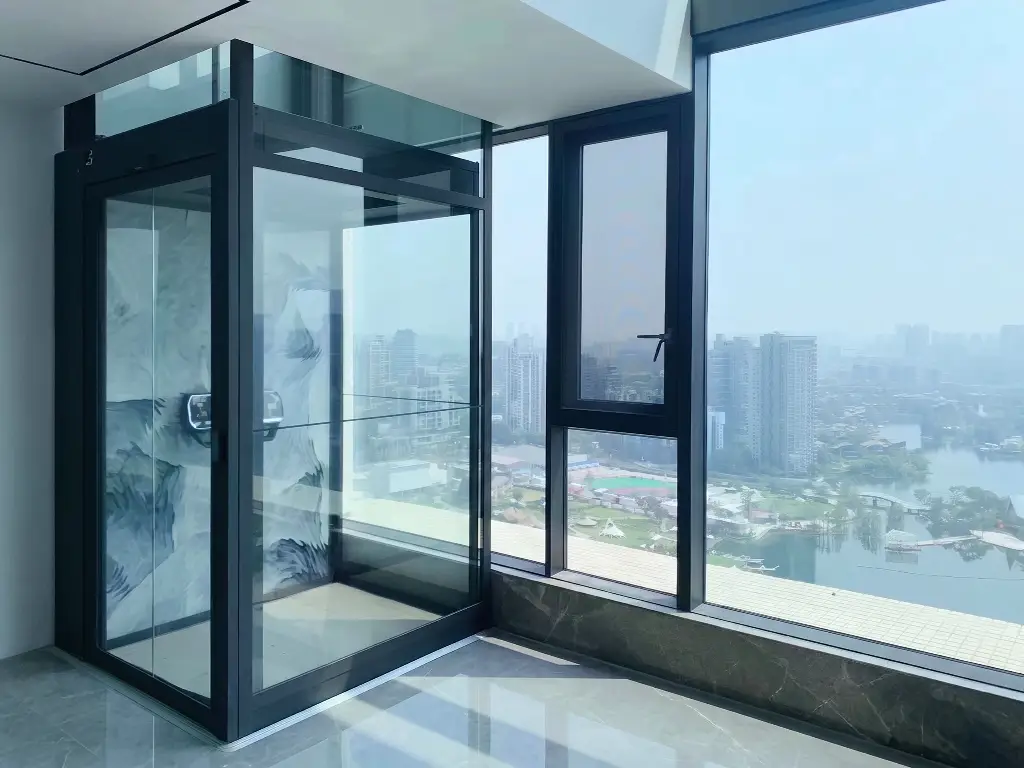
A Cibes V90 installed in a high-floor penthouse with panoramic glass shaft, complimenting the panoramic windows of the unit.
Why is screw-driven technology practical for UAE homes?
Screw-driven home lifts are practical because the drive system is compact.
A screw-driven lift does not need a separate machine room. This is useful in villas, duplex apartments, and penthouses where space is limited or where major structural work is not preferred.
Cibes screw-driven lifts are also designed with a modular shaft. This helps in retrofit projects because the lift can be installed with less dependence on a traditional concrete shaft.
For villas, this gives more freedom in lift placement.
For apartments and penthouses, it helps because the lift can be delivered in parts and assembled inside the property.
For architects, the benefit is clear: the lift can be planned around the real building, not only around a perfect drawing.
What regulations should homeowners consider in the UAE?
Lift approvals depend on the emirate, property type, project scope, and building condition.
A villa in Dubai may follow a different process from a penthouse in Abu Dhabi or an apartment in Sharjah. Master communities may also have their own rules.
As a general guide, villa projects are usually reviewed as building modifications. Apartment and penthouse projects may need building management approval, consultant review, fit-out permits, and authority approval if structure or fire safety is affected.
| Requirement | Villa | Apartment or penthouse |
|---|---|---|
| Owner approval | Usually direct from homeowner | Unit owner plus building management |
| Structural review | Needed for slab cutting or load changes | Usually more detailed |
| Authority approval | Depends on scope and emirate | Often needed for major work |
| Fire safety review | May apply for some changes | More sensitive due to shared building systems |
| Delivery access | Usually easier | Must follow building rules |
| Working hours | Community rules may apply | Often stricter in towers |
Homeowners should not treat approvals as a final step. They should be discussed before the lift location is confirmed.
Which lift type works best for villas?
Both platform lifts and cabin lifts can work well in villas.
A platform lift, such as the Cibes V80, can suit homes that need an open and panoramic feel. It is useful in stair halls, open living areas, and modern villa interiors. The V80 also allows flexible door access, which helps when the ground floor and upper floor layouts do not line up in a straight path.
A cabin lift, such as the Cibes V90, gives a more familiar elevator feel. It has an enclosed cabin and can still be designed with a panoramic glass shaft. This works well for homeowners who prefer more privacy and a traditional lift experience.
For villas with limited indoor space, an outdoor lift can also be considered. It may reduce changes inside the home and create a direct route to upper floors or roof areas.
Which lift type works best for apartments and penthouses?
For apartments and penthouses, the best lift is usually the one that fits the site with the least disruption.
A compact cabin lift works well when the homeowner wants an enclosed elevator feel. A platform lift can work in some duplex or triplex units where the space allows it.
The key factor is not only the lift model. It is the full site condition.
The project team must check the structure, access route, building rules, floor height, door position, and interior finish.
In penthouses, the lift is often part of the design. Glass panels, frame colour, door type, cabin finish, flooring, and lighting should all work with the home’s interior.
What should architects review before choosing the lift location?
Architects should review the lift position before finalising the interior layout.
The most important checks are:
- Floor-to-floor height
- Travel height
- Available headroom
- Pit or ramp requirement
- Shaft size
- Door access direction
- Landing space
- Structural support
- Electrical supply
- Delivery access
Travel height means the vertical distance the lift moves between floors. In many two-stop villas, this is often around 3 to 5 metres. In penthouses, the travel height depends on the internal level difference, slab thickness, ceiling build-up, and roof or terrace layout.
A small change in location can make a big difference. It can affect cost, approval, finishing, and daily comfort.
What mistakes should homeowners avoid?
The biggest mistake is choosing the lift too late.
If the flooring, ceiling, joinery, lighting, and furniture layout are already final, the lift may feel forced into the space.
Another mistake is focusing only on the home lift price. The full project may also include civil work, slab cutting, finishing, electrical work, and approval-related costs.
A third mistake is assuming that every compact lift can fit every property. Even a small home lift still needs the right structure, height, access, and landing space.
A site survey is always important. It helps confirm what is possible before the homeowner commits to a layout or model.
What is the best lift approach for each home type?
| Home type | Suitable approach | Why it works |
|---|---|---|
| Existing villa | Indoor or outdoor modular screw-driven lift | Flexible placement with less major building work |
| New villa | Lift planned early in the design | Cleaner layout and easier coordination |
| Duplex apartment | Compact modular lift inside the unit | Works if structure and approvals allow |
| Triplex apartment | Cabin or platform lift with careful travel planning | Helps connect several private levels |
| Penthouse | Modular lift assembled on site | Helps with delivery access and premium finishes |
| Villa roof access | Two-stop lift from ground to roof | Useful when only selected floors need access |
The right answer depends on the building. A villa lift is usually about finding the best space. An apartment or penthouse lift is about balancing design, structure, access, and building rules.
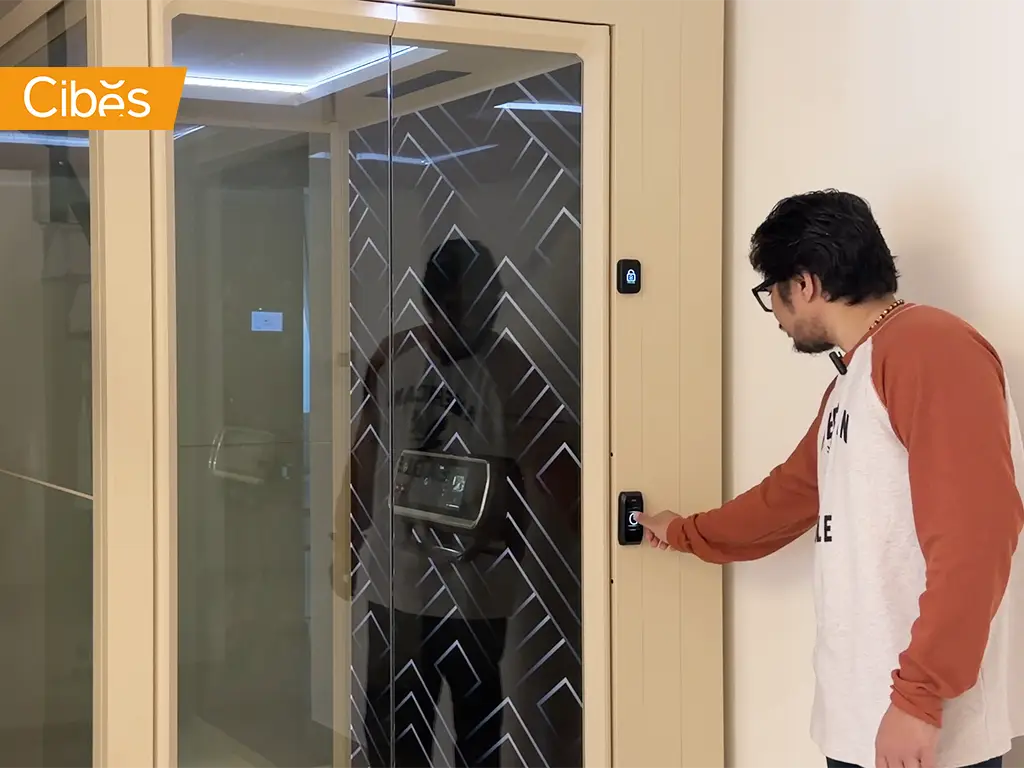
A homeowner testing the newly installed Cibes V90 in his villa in Sharjah.
Frequently Asked Questions (FAQs) About Home Lifts for Villas and Apartments in the UAE
Can a home lift be installed in an existing villa in Dubai?
Yes, many existing villas can accept a home lift if the structure and space allow it. Common locations include the stairwell, an unused corner, a slab opening, or an outdoor wall.
Can a private lift be installed inside an apartment?
It may be possible in a duplex, triplex, or large multi-level apartment. It is not usually needed in a single-floor apartment. Building management and structural approval may be required.
Why are penthouse lifts more complex than villa lifts?
A penthouse is part of a larger building. The lift must work with shared structure, delivery access, building management rules, fire safety, and premium interior finishes.
Is a screw-driven lift good for apartments and penthouses?
Yes, it can be a practical choice. Screw-driven lifts are compact, need no separate machine room, and can be built with a modular shaft. This helps when space and delivery access are limited.
Do villa lifts need a pit?
Some home lifts need a shallow pit, while others can be installed with little or no pit depending on the model and site condition. This should be confirmed during the site survey.
Can a villa lift go directly to the roof?
Yes, this can be possible if the structure, safety requirements, and approvals allow it. Some villas may use a two-stop lift from ground floor to roof, even if the house has more than two levels.
Which is better for a villa, platform lift or cabin lift?
A platform lift works well for open spaces and flexible door access. A cabin lift is better when the homeowner wants an enclosed elevator feel. Both can work if the site supports them.
What should architects prepare before speaking to a lift supplier?
Architects should prepare floor plans, sections, floor-to-floor heights, ceiling details, possible lift locations, and structural drawings if available. Photos of the site and delivery route are also helpful.