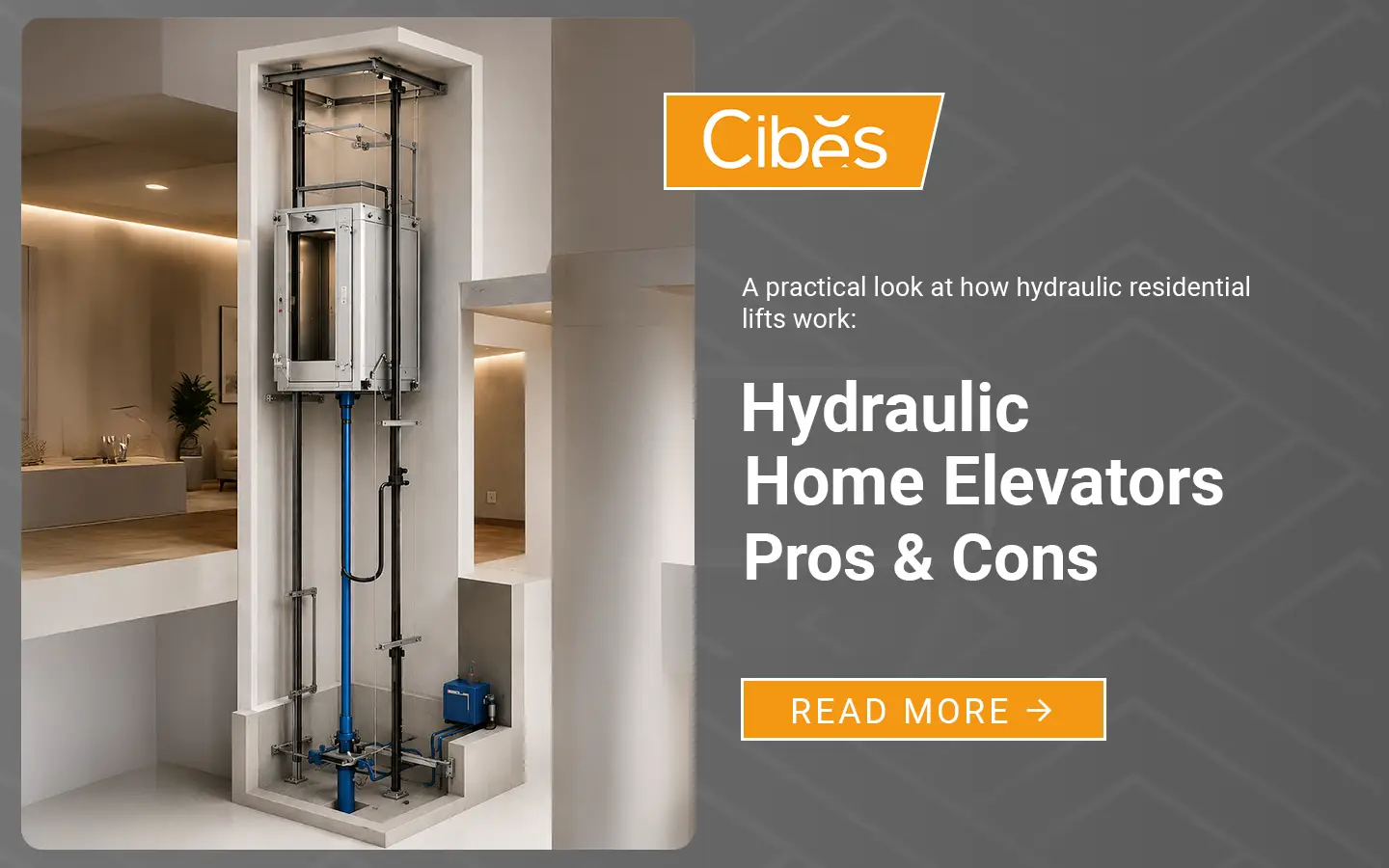
TL;DR: Hydraulic home elevators suit low-rise UAE villas where there is enough space for a shaft, pit and hydraulic equipment. They offer strong lifting capacity and a smooth ride, but usually need more civil work, regular fluid-system maintenance and careful heat management. Compare the full installation requirements with screw-driven and traction lifts before choosing.
How does a hydraulic home elevator work?
A hydraulic elevator raises the cabin by pumping fluid into a cylinder. Pressure moves a piston, and the piston lifts the cabin directly or through another mechanical arrangement.
To travel down, the system opens a controlled valve. The fluid returns to the tank while gravity lowers the cabin.
Otis describes the principle simply:
“Hydraulic lifts operate on the principle of ‘push’.”
Its explanation of how hydraulic lifts work helps separate the hydraulic principle from traction elevators, which pull the cabin using ropes or belts and a counterweight.
Are all hydraulic home elevators the same?
No. This is one of the most important points to understand before comparing quotations.
Common configurations include:
- Direct-acting hydraulic systems, where the piston acts on the cabin or its supporting frame.
- Holeless hydraulic systems, where cylinders sit within the shaft instead of extending into a deep bore beneath it.
- Roped hydraulic systems, where a piston and sheave arrangement moves the cabin through suspension ropes.
The exact pit, shaft, equipment space, travel and power requirements depend on the model.
“Hydraulic” is a drive category, not one fixed specification. Holeless and machine-roomless hydraulic products also exist, so claims such as “every hydraulic lift needs a deep bore and separate machine room” are inaccurate.
“Home lift” is also a broad market term, not a complete technical classification. The applicable safety requirements depend on the product’s design, speed, rated load, travel and intended use.
Ask the supplier to identify the product classification and compliance basis in writing. Elevator safety standards can cover design, installation, inspection, testing, operation and maintenance, not only the drive mechanism.
What are the main advantages of a hydraulic home elevator?
Hydraulic technology has remained in use because it serves certain low-rise projects well.
It suits low-rise travel
Hydraulic elevators are mainly associated with low-rise buildings. That can make them suitable for a two-storey or three-storey villa when the property has enough room for the required shaft and equipment.
Schindler’s overview of elevator hoist systems also places hydraulic elevators mainly in low-rise applications.
This does not mean every hydraulic model supports the same number of floors. The certified maximum travel and stop limits still control the decision.
It can provide useful lifting capacity
Hydraulic pressure can move substantial loads at low-rise speeds. This can help when the cabin must carry several passengers, a wheelchair, mobility equipment or household items.
Do not compare capacity from the drive name alone. Compare:
- Certified rated load
- Clear internal cabin size
- Clear door opening
- Usable floor area
- Entrance configuration
A large stated load is not useful when the cabin or entrance does not suit the person using it.
The ride can feel stable and controlled
A well-designed and correctly adjusted hydraulic valve system can provide gradual acceleration and controlled floor levelling. Many users associate hydraulic elevators with a solid cabin feel.
Ride quality still depends on more than the drive. Guide rails, frame stiffness, valve control, installation accuracy and maintenance all affect the experience.
Experience an operating unit instead of relying only on words such as “smooth,” “quiet” or “premium.”
Emergency lowering can be straightforward
Many hydraulic systems can lower the cabin using gravity when the correct emergency controls are activated. Depending on the product, this may use battery power or a manual lowering valve.
Confirm these points before purchase:
- Where will the cabin stop during a power failure?
- Will it travel to the nearest floor or only downward?
- How will the doors open?
- Who can operate the manual lowering system?
- How often will the emergency battery be tested?
Emergency behaviour is product-specific. It should be demonstrated during handover.
What are the disadvantages of hydraulic home elevators?
These are not automatic reasons to reject hydraulic technology. They are project and ownership factors that must be planned from the beginning.
Building work can be significant
A conventional hydraulic home elevator may need a constructed shaft, pit, structural supports and a separate or adjacent equipment area.
Some newer products reduce these requirements. However, “machine-roomless” or “holeless” does not mean “no building work.”
For an existing UAE villa, civil work can decide whether the system is practical. The project may involve:
- Slab cutting
- Pit construction
- Waterproofing
- Structural supports
- Shaft construction
- Electrical preparation
- Floor and wall finishing
The lift quotation should clearly separate the equipment price from civil works, authority approvals, electrical work and interior finishing.
This is especially important when comparing a hydraulic elevator with a modular home lift. A lower equipment price can become less attractive once the full building scope is included.
The system contains fluid and wear components
Hydraulic systems use fluid, seals, valves, pipes or hoses, a tank, pump and cylinder. These parts require inspection.
Performance can be affected by worn seals, contamination, valve condition or unsuitable fluid.
Ask the supplier:
- What hydraulic fluid does the lift use?
- How are leaks detected and contained?
- Which seals, valves and hoses are normal wear items?
- How often is fluid condition checked?
- Are replacement parts stocked in the UAE?
- Who is responsible for disposing of used fluid?
Biodegradable hydraulic fluids are available for some products, but they do not remove the need for leak prevention and proper handling.
Equipment temperature matters in the UAE
Dubai and Abu Dhabi can place lift equipment in hot garages, rooftops, service areas or external cabinets.
The pump, hydraulic fluid, controller and emergency battery should operate within the temperature and ventilation limits stated by the manufacturer.
Do not accept a broad claim that the lift is simply “made for UAE weather.” Ask for:
- The permitted equipment temperature range
- Required ventilation or air conditioning
- The protection rating of external cabinets
- Maximum humidity limits
- The party responsible for maintaining these conditions
- What happens when the temperature exceeds the permitted range
This matters even more for outdoor lifts. A weather-resistant lift shaft does not automatically mean the pump, controller and battery can remain in an unconditioned outdoor space.
Active-travel energy use can be higher
A hydraulic pump must create enough pressure to raise the cabin and its load.
A traction elevator uses a counterweight to offset much of the moving mass. Hydraulic elevators therefore tend to use more energy during active travel than efficient counterweighted traction systems.
The real difference in a private villa depends on:
- Cabin and rated load
- Total travel
- Motor and pump design
- Number of daily trips
- Controller standby demand
- Cabin lighting and ventilation
- Equipment temperature
A home elevator may spend far more time waiting than moving. Standby consumption can therefore matter as much as travel consumption in a low-use villa.
Ask each supplier for a model-specific estimate based on the same travel height and expected number of trips. ISO 25745-2 provides a standard method for estimating annual energy use for hydraulic, traction and positive-drive lifts. This is more useful than comparing motor ratings alone.
Travel and speed are more limited than traction
Hydraulic systems are generally used for shorter travel and lower speeds than traction elevators. This is rarely a problem in a two-level home, but it matters more as the total rise, number of stops and daily usage increase.
Longer travel can also affect waiting time, motor duty and fluid temperature.
A system that suits occasional household use may not suit frequent movement in a busy multi-level property.
Periodic re-levelling may be needed
Small changes in hydraulic pressure or fluid movement can allow a parked cabin to move slightly away from the exact floor level.
Modern controls can detect this movement and re-level the cabin.
Ask how the proposed model manages re-levelling, how much movement triggers correction, and whether the process affects standby energy or creates noise near bedrooms.
When is a hydraulic residential lift a good fit?
A hydraulic lift deserves consideration when the project has most of these conditions:
| Project condition | Why hydraulic may fit |
| Two to a few residential levels | Hydraulic systems are commonly designed for low-rise travel |
| New villa or major renovation | The shaft, pit and equipment area can be planned early |
| Conventional enclosed cabin required | Many hydraulic products use a full cabin |
| Moderate daily use | Active-travel energy has less impact than in a busy building |
| Suitable service space | The pump, tank and controller can be protected and maintained |
| Strong local service support | Technicians and replacement parts are available |
Hydraulic technology may be less suitable when the property has:
- Very limited installation space
- Little tolerance for structural work
- A long travel distance
- High daily usage
- No suitable equipment location
- An unconditioned outdoor service area
- Limited access for future maintenance
A retrofit does not automatically rule it out. It simply makes a detailed site survey and complete civil-work scope more important.
How does hydraulic compare with screw-driven and traction lifts?
The drive should follow the building and user needs. It should not be chosen from one marketing claim.
| Decision point | Hydraulic | Screw-driven | Traction |
| Typical application | Low-rise cabin elevators | Low-rise home and platform lifts | Low-rise to high-rise elevators |
| Lifting principle | Pump, fluid, cylinder and piston | Drive nut travels along a fixed screw | Ropes or belts, sheave and counterweight |
| Pit and machine space | Often required, but model-dependent | Often a small pit and no separate machine room | Model-dependent, with many machine-roomless products |
| Travel and speed | Shorter, slower travel | Low-speed residential travel | Longer travel and higher speed |
| Main service focus | Fluid, seals, valves, pump and cylinder | Screw, drive nut, lubrication and safety systems | Suspension media, brake, motor and controls |
| Best project question | Can the home support the civil and equipment needs? | Is compact installation more important than speed? | Does the home need more speed, travel or usage capacity? |
The article on traction vs hydraulic vs screw-driven home lifts in the UAE provides a broader side-by-side comparison.
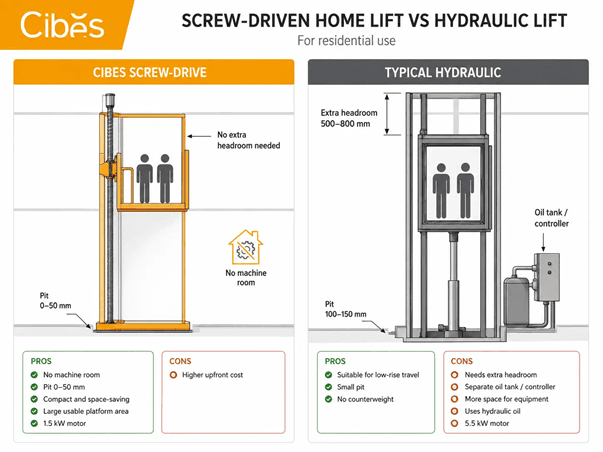
A screw-driven home lift can make more sense when the priority is a compact modular shaft, very small pit and no separate machine room.
That does not make screw drive universally better. It usually works at a lower speed and has its own maintenance and sound characteristics.
Traction can make more sense for longer travel, greater speed or higher usage. It may also reduce active-travel energy through its counterweight, although the result depends on the complete elevator design.
What should you check before choosing one?
Use this four-part test.
1. Check the building
Confirm:
- Clear shaft size
- Pit and overhead
- Structural loads
- Equipment position
- Installation access
- Slab openings
- Waterproofing
- Civil-work responsibility
Do not approve the project using only the cabin dimensions. The complete shaft and equipment layout determines whether the lift will fit.
2. Check the users
Confirm:
- Number of passengers
- Wheelchair or mobility needs
- Required clear door width
- Internal cabin size
- Door configuration
- Control height
- Expected daily trips
Start with the people using the elevator. Technology comes after their needs are clear.
3. Check the environment
Confirm:
- Equipment temperature range
- Ventilation or cooling
- Outdoor protection
- Drainage and waterproofing
- Electrical supply
- Emergency power arrangement
- Access for maintenance
These details are particularly important in UAE outdoor and rooftop installations.
4. Check long-term support
Confirm:
- Maintenance schedule
- Emergency response time
- Warranty exclusions
- Fluid specification
- Normal wear components
- Spare-parts availability
- Technician availability in your emirate
The wider process of planning a home lift in the UAE should begin with users, space, floors and long-term service. Drive technology comes after those needs are clear.
For homeowners comparing a home elevator & residential lift solution in UAE, the best choice is not the system with the longest list of claimed benefits. It is the product whose certified limits, building requirements and maintenance plan match the property.
Are hydraulic home elevators worth considering?
Yes, especially for a planned low-rise villa with enough shaft, pit and service space.
Hydraulic technology can provide a stable enclosed cabin, useful load capacity and controlled emergency lowering.
Its disadvantages matter more in compact retrofits, hot unconditioned equipment areas, longer travel and projects that aim to minimise civil work or active-travel energy.
Compare the complete installation and ownership plan, not only the drive name or equipment price.
Frequently asked questions about Hydraulic home elevators
Are hydraulic home elevators safe?
They can be safe when the complete system is correctly designed, certified, installed and maintained.
Ask for the applicable standard, model certification, door interlocks, emergency lowering system, levelling controls and maintenance requirements.
Does a hydraulic home elevator need a machine room?
Many hydraulic systems need a machine room or dedicated equipment area for the pump, tank and controller.
Some modern products use compact or machine-roomless arrangements. Confirm the actual layout from project-specific drawings.
Does every hydraulic elevator need a deep pit?
No.
Holeless systems avoid a deep underground jack bore, but they may still need a conventional elevator pit. “Holeless” does not mean “pitless.”
Is a hydraulic elevator suitable for an existing villa?
It can be when the property can accommodate the shaft, pit, structural loads, equipment location and installation access.
Other drive types may require less civil work in a tight retrofit.
Are hydraulic elevators expensive to maintain?
Maintenance cost depends on the model, age, usage, service access and parts support.
Request a written schedule covering the fluid, seals, valves, pump, cylinder, levelling system and emergency equipment.
Which is better, hydraulic or screw-driven?
Neither is automatically better.
Hydraulic can suit a conventional low-rise cabin where civil work and equipment space are already planned. Screw drive can suit a compact home where a small pit, modular shaft and no separate machine room are priorities.