

TL;DR:
- Accessibility solutions in the UAE support people of determination, elderly users, and families living in multi-level homes.
- UAE laws and local codes require accessible paths, lifts, ramps, and facilities in many buildings.
- Common solutions include home lifts, platform lifts, ramps, accessible bathrooms, and clear signage.
- Home lifts are the most practical option for villas because they remove stair barriers and support daily independence.
- Cibes Lift provides factory direct home lifts and platform lifts in the UAE, designed in Sweden with global production.
- This pillar connects to clusters on wheelchair access, home lift choices, retrofitting, and safe mobility for families.
Accessibility is a growing priority in the UAE. Families want safer homes for elderly parents and loved ones with mobility needs. Businesses and public bodies must also provide access for people of determination in line with UAE laws and local building codes.
This guide explains what accessibility solutions are, how UAE laws and codes support them, and which options are most useful for private homes, commercial buildings, and public spaces. It also shows how home lifts and platform lifts fit into the wider picture of accessibility in the UAE.
What are Accessibility Solutions in the UAE
Accessibility solutions are products and design features that make it easier and safer for people with different abilities to move, work, and live independently. In the UAE, the term people of determination is used for persons with disabilities, reflecting the focus on capability and inclusion.
Accessibility solutions can include:
- Home lifts and platform lifts
- Elevators in multi storey buildings
- Wheelchair ramps and level entrances
- Stairlifts
- Accessible toilets and bathrooms
- Wider doorways and circulation areas
- Handrails and grab bars
- Tactile and Braille signs in public areas
These solutions appear in UAE villas, apartments, residential towers, hotels, clinics, schools, malls, offices, and government buildings.
What do UAE laws say about Accessibility and People of Determination
The UAE has a strong legal and policy framework to protect the rights of people of determination, including the right to access buildings, services, and information.
Key elements include:
- Federal Law Number 29 of 2006 concerning the Rights of People with Special Needs, as amended, which guarantees support and services for people with disabilities and calls for integration in all areas of life.
- The National Policy for Empowering People of Determination, which sets goals for accessibility in buildings, transport, information, and daily life, and calls for unified accessibility standards across the UAE.
- Local laws, such as Dubai Law Number 3 of 2022 concerning the rights of persons with disabilities in the Emirate of Dubai, which focuses on independent living and an accessible environment.
Government portals for the UAE and local human rights bodies clearly state that people of determination must have equal access to education, housing, health care, transport, and public life.
These frameworks do not list every product or brand, but they support the principle that the built environment, services, and digital spaces should be accessible.
Which UAE building codes and design standards cover accessibility
Accessibility in physical buildings is reinforced by local codes and guides.
Important references include:
- Dubai Universal Design Code, which sets detailed accessibility standards for the built environment, transport, and wayfinding in Dubai. It covers ramps, doors, sanitary facilities, signage, and many design details.
- Abu Dhabi International Accessibility Standards, which define requirements for accessible and usable buildings and facilities in the Emirate of Abu Dhabi.
- Dubai Building Code, which unifies building rules in Dubai and refers to accessibility requirements linked to the Dubai Universal Design Code.
- Other design guidelines, such as Trakhees design regulations, which include clear criteria for ramp width, slope, landings, and non-slippery surfaces for public and service ramps.
As an example of real-life application, the COP28 site in the UAE was planned to be compliant with the UAE Universal Code for the built environment and to offer accessible paths, Braille signposts, and accessible digital services.
These codes mean that lifts, ramps, entrances, corridors, and sanitary facilities in new projects must be planned with accessibility in mind.
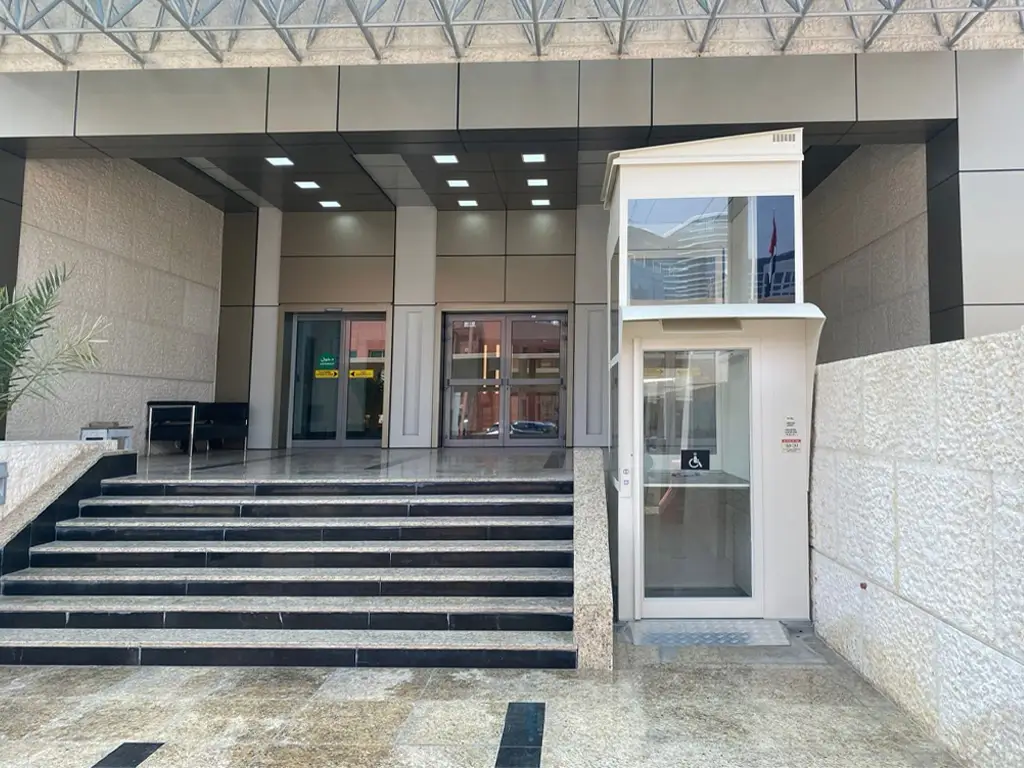
A Cibes Voyager platform lift installed in Abu Dhabi Judicial Courthouse.
What types of accessibility solutions are common in the UAE
Accessibility solutions can be grouped into a few main categories.
1. Vertical mobility solutions
These help people move between levels where stairs exist.
- Home lifts and residential elevators for villas and residential towers
- Platform lifts for wheelchairs in homes, clinics, retail, and public facilities
- Elevators in multi storey buildings, required to form an accessible path in housing buildings in many cases (see Trakhees Accreditation)
- Stairlifts where installing a lift is not possible
2. Horizontal and entrance access
These make it easier to enter or move across a building without barriers.
- Ramps at entrances and internal level changes
- Level thresholds instead of steps
- Wider corridors for wheelchairs
Local standards often specify minimum ramp width, maximum slope, and landing sizes for ramps in public buildings.
3. Accessible facilities and signage
These support safety and independence inside buildings.
- Accessible toilets and bathrooms
- Handrails and grab bars near stairs and in sanitary spaces
- Braille and tactile signs in public areas
- Audio and visual signals in lifts and public transport
4. Digital accessibility
The UAE also promotes digital accessibility. The national design system explains how websites and apps should follow international accessibility guidelines, such as WCAG, to support people of determination online.
Why home lifts are a key accessibility solution for UAE villas
In the UAE, many villas and townhouses have two or more floors. Stairs can become a barrier when a family member grows older, uses a wheelchair, or simply feels less stable.
Home lifts are a strong accessibility solution because they:
- Remove the need to climb stairs
- Support wheelchair users and people with walkers
- Help multi-generational families share one home for longer
- Reduce fall risk on stairs
- Increase comfort for daily activities
- Can often be retrofitted into existing villas with limited space
Home lifts also fit well with UAE lifestyle expectations, where comfort, privacy, and family care are important.
How Cibes Lift supports accessibility in the UAE
Cibes Lift Group is one of the leading providers of home lifts and platform lifts designed for accessibility and comfort.
Key points about Cibes:
- The group is headquartered in Sweden
- There are four main factories located in Sweden, China, Poland, and the USA
- Cibes has direct operations in more than twenty countries, including the UAE
- In the UAE, Cibes offers factory direct home lifts and platform lifts
Cibes solutions are designed to support accessibility for wheelchair users, elderly family members, and people with mobility challenges, while also offering a modern appearance that fits premium homes and high-quality commercial spaces.
Cibes home lifts and platform lifts can be used in:
- Private villas and townhouses
- Multi-generational homes
- Clinics and medical centers
- Hotels and serviced apartments
- Offices and showrooms
- Public and semi-public buildings where vertical access is needed
How accessibility solutions support commercial and public buildings in the UAE
Commercial and public buildings in the UAE are expected to support inclusive access for all visitors and employees. Government guidance speaks about accessible environments and the need for people of determination to enter and use public facilities independently.
Typical solutions include:
- Elevators and platform lifts at main circulation points
- Fully accessible paths from car parks and public transport to building entrances
- Ramps with correct slope and width where level changes exist
- Accessible toilets on common floors
- Tactile surfaces and Braille signage at key points
- Accessible customer service counters
Projects and operators that follow these guidelines not only comply with law and code but also provide better user experience and brand image.
How to choose the right accessibility solution in the UAE
Choosing the right solution depends on a few key questions.
1. What is the mobility need
- Wheelchair user who must stay seated
- Elderly person who can walk a little but not climb stairs safely
- Person with visual or hearing impairment who needs better wayfinding and signals
2. How many floors are in the building
- For two or more floors in a home, a home lift is usually the best long-term answer
- For one floor step or small level change, a ramp or short platform lift may be enough
3. Is this a new project or an existing villa
- New projects can plan lift shafts and accessible routes from the start
- Existing villas may use compact home lifts or platform lifts that fit into stairs or unused corners
4. What are safety and comfort expectations
- Families often want solutions that are safe for children and grandparents
- Commercial sites must make it easy for visitors to move without assistance
- Many accessibility products follow global safety rules. For example, EN 81-41 is a European standard that defines the safety requirements for vertical lifting platforms for persons with impaired mobility. It covers platform protection, emergency controls, speed limits, safe doors, and reliable operation.
In many multi-level homes in the UAE, a home lift is the most complete solution for accessibility and long-term independent living.


Frequently Asked Questions (FAQs) About Accessibility Solutions in the UAE
Q: What is the main law that protects people of determination in the UAE
A: Federal Law Number 29 of 2006 concerning the Rights of People with Special Needs, as amended, protects the rights of people of determination and supports their access to services, facilities, and rehabilitation.
Q: Are accessibility requirements the same in all Emirates
A: The UAE has federal laws and national policies, and each Emirate also has local codes and standards, such as the Dubai Universal Design Code and Abu Dhabi International Accessibility Standards, which give detailed design rules for the built environment.
Q: Can a home lift be added to an existing villa in the UAE
A: Yes. Many modern home lifts are designed to be retrofitted into existing villas with minimal structural changes, for example inside stair openings or along an external wall. This makes them a practical accessibility solution for families who want to stay in their current home.
Q: What is the best solution for a wheelchair user in a two-floor home
A: For a wheelchair user who needs to move between floors every day, a home lift or a fully enclosed platform lift is usually safer and more comfortable than a stairlift, because the user stays in the wheelchair and the platform is designed for this use.
Q: Do UAE codes require lifts in multi-storey housing
A: Local design codes state that multi storey buildings should provide elevators to create an accessible route to residences, which supports independent access for people of determination.
Q: Is Cibes a suitable option for accessibility projects in the UAE
A: Yes. Cibes is a global manufacturer with Swedish headquarters, four major factories, and direct operations in the UAE. Its home lifts and platform lifts are widely used as accessibility solutions in villas, commercial spaces, and public projects, and provide a factory direct service model.
