TLDR: A home elevator rated at 0.15 m/s travels about 9 meters per minute at rated speed. That may sound slow beside a conventional passenger elevator, but speed is only one part of the design. EN 81-41:2024 covers certain vertical lifting platforms with a rated speed not greater than 0.15 m/s. Many Cibes platform lifts follow this low-speed approach. Other Cibes solutions are faster. The V90 can be specified at up to 0.25 m/s in certain configurations, while Gravital reaches up to 0.4 m/s. The right speed depends on your travel height, number of floors, expected usage, building conditions and the type of lift being installed.
How fast does a home elevator actually travel?
Home elevator speed is usually stated in meters per second, or m/s.
The number describes the lift’s rated travelling speed. It does not tell you the complete door-to-door journey time.
Here is a simple comparison:
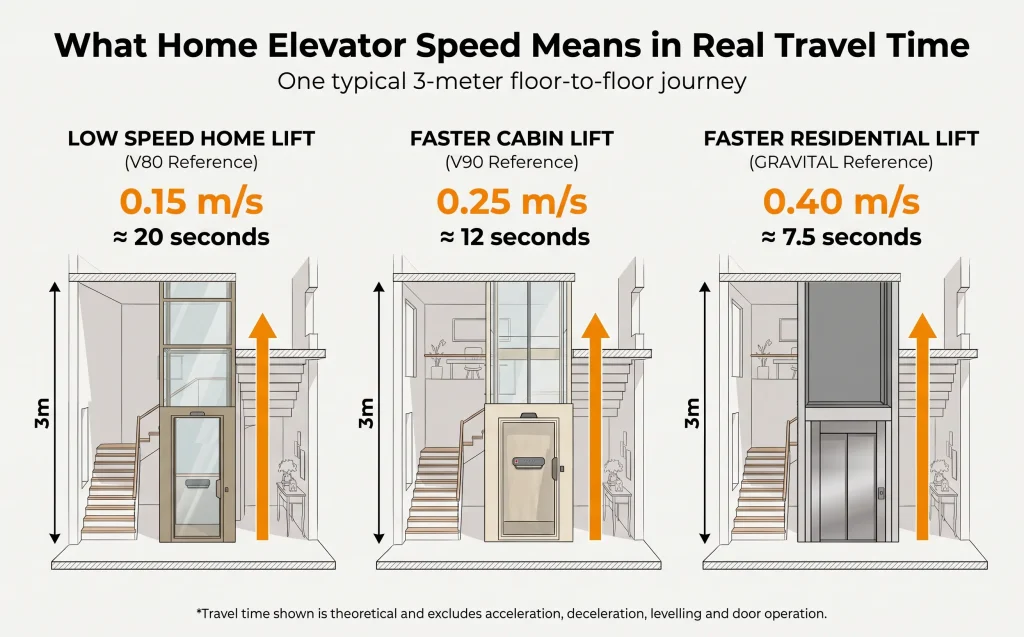
| Vertical travel | 0.15 m/s | 0.25 m/s | 0.4 m/s | 1.0 m/s |
| 3 meters | 20 sec | 12 sec | 7.5 sec | 3 sec |
| 6 meters | 40 sec | 24 sec | 15 sec | 6 sec |
| 9 meters | 60 sec | 36 sec | 22.5 sec | 9 sec |
These figures are theoretical. They simply divide travel distance by rated speed.
A real journey takes longer. The lift needs time to start smoothly, accelerate, slow down, stop accurately at the landing and open its doors.
Is 0.15 m/s too slow for a villa?
It depends on how you use the lift.
Imagine a two-floor villa with roughly 3 meters between floors. At 0.15 m/s, the theoretical travelling time is about 20 seconds.
For a homeowner using the lift several times per day, that may be perfectly reasonable.
Now consider a residence with five or six stops and a much greater total travel height. A 0.15 m/s lift will spend noticeably longer travelling between the lowest and highest floors. In that situation, speed deserves more weight in the decision.
This is why asking only “How fast is the elevator?” rarely gives you enough information.
A better question is: How appropriate is this speed for the height, usage and design of my home?
Why are many European home lifts rated at 0.15 m/s?
The 0.15 m/s figure has an important technical background.
The current EN 81-41:2024 standard covers certain electrically powered vertical lifting platforms intended for people with impaired mobility. Its scope includes platforms with several possible drive technologies, including screw and nut, traction, toothed belt and hydraulic systems. One of its defining conditions is a rated speed not greater than 0.15 m/s.
That means 0.15 m/s is not a speed chosen simply because a manufacturer wants a lift to move slowly.
It forms part of the technical definition of this particular category of lifting platform.
How is this different from a conventional passenger elevator?
The distinction is also visible in European lift legislation. The EU Lifts Directive 2014/33/EU specifically excludes lifting appliances whose speed does not exceed 0.15 m/s from its scope.
EN 81-20, which covers conventional passenger and goods passenger lifts, similarly excludes lifts with rated speeds of 0.15 m/s or below from its scope.
So there is an important distinction:
Up to 0.15 m/s: certain low-speed lifting platforms can fall within the EN 81-41 framework where its other scope conditions are also met.
Above 0.15 m/s: the lift may fall into a different product and regulatory category, depending on its design and application.
This does not mean that one category is safe and another is unsafe. They are engineered under different requirements.
For a deeper explanation, our EN 81-41 guide for UAE homeowners explains what the standard covers and, just as importantly, what it does not cover.
A 2026 regulatory note
Cibes technical documentation currently references Machinery Directive 2006/42/EC for relevant products. The EU’s newer Machinery Regulation (EU) 2023/1230 is scheduled to apply from 20 January 2027, replacing the existing directive framework.
For architects and consultants specifying projects beyond 2026, product documentation should therefore be checked against the requirements in force at the time of supply.
What factors determine home elevator speed?
Speed does not come from the motor alone. It is part of the lift’s complete engineering design.
1. Lift category and applicable standards
A vertical platform lift, compact cabin lift and conventional passenger elevator are not necessarily the same type of product.
Their required safety systems, controls, carrier design, operating characteristics and conformity procedures can differ.
This is one reason comparing two quotations based only on “0.15 m/s versus 0.4 m/s” can be misleading. First compare what type of lift is actually being offered.
2. Total travel height and number of stops
The longer the vertical journey, the more valuable additional speed becomes.
Saving ten seconds on a short journey between two floors may not matter much to one homeowner. Saving substantially more time on repeated journeys through five or six floors could matter a lot.
Architects should therefore look at total travel height, not simply the number of storeys.
3. Expected daily use
A private villa carrying a few family members has a very different traffic pattern from a hotel, office or busy residential building.
Low-speed lifts can make sense where daily traffic is moderate.
Where many people need to move repeatedly between floors, journey time and handling capacity become much more important.
4. Drive system and overall lift design
Screw-driven, hydraulic, traction and belt-driven technologies have different mechanical characteristics.
But it is incorrect to assume: “Screw-driven means slow, hydraulic means medium, traction means fast.”
EN 81-41 itself includes several drive technologies within its low-speed platform scope. A hydraulic or traction system can therefore also be designed as a low-speed lifting platform.
The more useful distinction is between the lift’s product category and the technology used to move it.
You can see how the screw and nut mechanism works in our guide to screw-driven home lift technology.
5. Acceleration, deceleration and levelling
Rated speed does not tell you how a lift feels.
Ride quality also depends on how smoothly the lift starts, reaches cruising speed, slows down and levels with the floor.
A 0.15 m/s lift can provide a refined residential ride. A faster lift can still feel uncomfortable if acceleration, braking or levelling is poorly controlled.
For this reason, homeowners comparing premium lifts should experience the actual product rather than judge ride quality from a specification sheet.
6. Building constraints
Speed alone does not determine pit depth, headroom or shaft dimensions.
However, faster lift concepts often belong to product categories with different structural and safety requirements. The exact relationship depends on the lift.
For example, the Cibes V80 travels at 0.15 m/s and uses an integrated screw and nut drive. Its current UAE specification lists a 50 mm pit and no separate machine room.
These compact requirements are one reason low-speed home lifts are often considered for existing villas where major structural work is difficult. Our guide to home lifts without a deep pit or separate machine room explains this building side in more detail.
How fast are Cibes home lifts?
There is no single “Cibes speed”.
Different models are designed for different applications.
| Cibes model or concept | Rated speed | Drive concept | Typical design priority |
| Cibes V80 platform lift | 0.15 m/s | Screw and nut | Compact residential installation |
| Cibes V90 cabin lift | 0.15 m/s, up to 0.25 m/s with applicable 3-phase configuration | Screw and nut | Enclosed cabin with compact integrated design |
| Gravital | Up to 0.4 m/s | Steel belt and counterweight | Faster conventional-style cabin experience |
Current UAE specifications list the V80 at 0.15 m/s. The Cibes V90 cabin lift is specified at 0.15 m/s with an option of 0.25 m/s when using the applicable three-phase configuration. Gravital lift reaches a maximum rated speed of 0.4 m/s.
Why does Cibes use 0.15 m/s on its platform lifts?
Cibes is a Swedish manufacturer with a history dating to 1947 and decades of experience with screw-driven lift technology. The important point, however, is not simply that the company is Swedish. It is how each product is engineered, tested and documented.
Cibes platform lifts are designed around the European low-speed lifting-platform concept, where EN 81-41 specifies a maximum rated speed of 0.15 m/s for products within its scope.
That speed fits a broader engineering approach.
Instead of prioritising maximum travel speed, products such as the V80 prioritise factors such as compact dimensions, integrated machinery, a shallow pit and easier installation into low-rise buildings.
This is particularly relevant to the UAE, where many home lift installations involve finished villas that were never originally designed around a conventional elevator shaft.
Why can Gravital travel faster?
Gravital uses a different lift architecture. It has a steel belt and counterweight drive and reaches up to 0.4 m/s.
Its current specification also calls for a 200 mm pit, compared with the shallower requirements of Cibes’ main screw-driven platform range.
This illustrates the main lesson of this article.
Speed is part of a complete lift design.
A homeowner choosing between 0.15 m/s and 0.4 m/s is not simply choosing between a slow motor and a fast motor. They may be comparing two different lift concepts with different space requirements, drive systems and installation conditions.
Does a slower home elevator mean a safer elevator?
No.
A lower speed does not automatically make a lift safe, just as a higher speed does not automatically make one unsafe.
A properly designed passenger elevator travelling considerably faster than 0.15 m/s can be extremely safe.
Home elevator safety depends on the complete system.
- Are the landing doors safely interlocked?
- How does the lift detect an obstruction?
- What stopping or braking systems are provided?
- What happens during a power failure?
- Is emergency communication available?
- How does the lift prevent unintended movement?
- What standards apply to the exact product?
- Has it been installed according to the manufacturer’s requirements?
- Who will maintain it after installation?
Cibes documentation, for example, describes safety functions including interlocked landing doors, emergency lowering during a power failure, emergency communication and pressure-sensitive safety edges on relevant platform models. See the Cibes user guide for model-specific documentation.
The exact equipment varies by model, which is why the product specification and handover documentation matter more than a general claim that one technology is “the safest”.
Our home lift safety guide for the UAE covers these systems separately.
What about elderly and wheelchair users?
Rated speed is only one consideration.
For a person with reduced mobility, other details can be just as important:
- smooth starting and stopping
- accurate floor levelling
- clear door opening
- wheelchair manoeuvring space
- accessible controls
- door operating time
- emergency communication
- operation during power failure
A homeowner buying a lift for ageing parents should therefore avoid choosing purely from the fastest number in a brochure.
The goal is safe, comfortable and practical movement through the home.
What home elevator speed should you choose for a UAE villa?
There is no universal ideal speed.
For many two and three-storey villas, a 0.15 m/s home lift can make sense when space efficiency, easier retrofit and limited building work matter more than saving a few seconds.
A faster cabin or passenger lift deserves stronger consideration when the property has greater vertical travel, more stops, frequent daily journeys or occupants who place a high value on shorter journey times.
Before comparing speeds, ask these questions:
- How many floors will the lift serve?
- What is the total vertical travel?
- How often will the lift be used each day?
- Who will use it most often?
- Is the property new or already completed?
- How much pit and headroom are available?
- Is there space for the required shaft and machinery?
- What lift category and safety standards apply?
- What happens if the electricity fails?
- Can you experience the actual lift before deciding?
Speed should come after these questions, not before them.
The broader process in our guide on how to choose a home lift for a UAE villa can help put speed, space, safety and long-term use into the same decision.
FAQs About Home Elevator Speed
Is 0.15 m/s slow for a home elevator?
Compared with a conventional passenger elevator, yes, 0.15 m/s is relatively slow. But for a low-rise villa, the practical difference may only be several seconds per floor. Whether that matters depends on travel height and how frequently you use the lift.
How long does a 0.15 m/s lift take to travel one floor?
If the vertical distance is 3 meters, the theoretical travel time is around 20 seconds. The actual journey takes longer because of acceleration, deceleration, levelling and door operation.
Why can’t a 0.15 m/s home lift simply be programmed to travel at 0.3 or 0.4 m/s?
Because rated speed forms part of the lift’s complete engineering and conformity design. Increasing speed can affect braking, stopping distances, safety systems, control logic, testing and the standards or regulatory category that apply. It is not simply a software adjustment.
Does screw-driven technology have to travel at 0.15 m/s?
No. Drive technology and lift category are different issues. The 0.15 m/s threshold is associated with specific low-speed lifting-platform standards and product designs, not with every screw-driven system in existence.
Is a 0.4 m/s home elevator better than a 0.15 m/s lift?
It is faster, but that does not automatically make it better for every home. Compare travel time together with shaft requirements, pit, headroom, available space, ride quality, installation work, safety systems and intended use.
What is the fastest Cibes home elevator available in the UAE?
Within the current UAE range discussed here, Gravital reaches a maximum rated speed of 0.4 m/s. Cibes’ main screw-driven platform products typically operate at 0.15 m/s, while certain cabin configurations such as the V70 can operate at up to 0.25 m/s.
Final thought: Don’t choose a home elevator by speed alone
Home elevator speed matters, but it needs context.
A faster lift can make sense when travel is long and usage is frequent. A 0.15 m/s low-speed lift can make more sense when you are working with a low-rise villa, limited space or an existing building where structural impact matters.
Neither approach wins simply because one number is higher.
For homeowners and architects, the better comparison is the complete system: speed, travel height, safety standard, ride quality, space requirement, pit, machinery, installation and long-term service.
That gives you a much clearer picture of which home elevator actually fits the building and the people who will use it.