TL;DR: A safe home lift depends on the lift category, drive system, safety devices, installation, rescue procedure and maintenance, not on one feature alone. EN 81-41:2024 applies to certain vertical lifting platforms for people with impaired mobility, not every home elevator. For Cibes lifts, verify the exact model standard, rated load, door protection, emergency-lowering process and maintenance plan before purchase.
EN 81-41:2024 covers electrically powered vertical lifting platforms fixed to a building and intended for people with impaired mobility. Its scope includes screw-and-nut, traction and hydraulic drives. The standard is relevant to qualifying platform lifts, not every cabin-style home elevator.
What makes a home lift safe in the UAE?
Home lift safety is a system. The drive matters, but so do the doors, obstruction protection, stopping logic, emergency communication, rescue procedure, installation quality and maintenance. A useful safety comparison starts with the exact lift category and model, then checks how these layers work together.
| What to check | Why it matters | What to ask |
|---|---|---|
| Lift category and applicable standard | Confirms that the safety standard matches the product being supplied. | Ask for the exact standard and revision shown in the model documentation. |
| Drive and stopping method | Shows how normal motion is controlled and what physically supports the carrier. | Ask what happens if the motor or main power stops. |
| Doors and obstruction protection | Helps prevent movement with an unsafe door condition or a person or object in the travel area. | Check door interlocks, safety edges or light curtains used on the exact model. |
| Emergency lowering and communication | Defines how a passenger can exit after a power failure or fault. | Ask for the written rescue procedure and test it at handover. |
| Rated load and usable space | A lift can only be used safely within its stated load and layout limits. | Confirm rated load, platform or cabin size and landing clearances on the drawing. |
| Maintenance plan | Safety devices, locks, brakes and drive components need scheduled inspection. | Confirm service frequency, response process and who is qualified to work on the lift. |
Which safety standards apply to home lifts?
What does EN 81-41:2024 cover?
BS EN 81-41:2024 is a safety standard for electrically powered vertical lifting platforms fixed to a building and intended for use by people with impaired mobility, with or without a wheelchair. Its scope includes several drive types, including screw and nut, traction and hydraulic. This is why EN 81-41 should be matched to the lift category instead of used as a general badge for every home elevator.
What does IEC 61508 mean for a home lift?
IEC 61508 is a general functional-safety standard for electrical, electronic and programmable electronic safety-related systems. It can inform the design of safety-related control functions, but it does not prove that a home lift or controller has a particular SIL rating. If a supplier quotes SIL 2 or SIL 3, ask for the component or system certificate that supports that claim.
How do screw-driven, traction, hydraulic and vacuum lifts differ?
All four drive families can be engineered safely. The important difference is how they support and move the carrier, which safety devices they need, and how well the complete system fits the home. For a UAE villa, civil work, rescue access, rated load, use frequency and maintenance matter alongside the drive itself.
| Drive | How safety is achieved | What still needs checking | Where it can fit |
|---|---|---|---|
| Screw and nut | A motor rotates a drive nut along a fixed screw. Cibes designs use mechanical engagement to resist uncontrolled descent. | Wear, lubrication and safety-nut condition still need scheduled inspection. | Strong fit for low-speed residential projects where compact installation is important. |
| Traction | Ropes or belts move the car with a traction machine, usually with brakes and overspeed protection. | More components and building-space needs can apply, depending on the system. | Useful where higher speed, travel or traffic is required. |
| Hydraulic | A hydraulic jack moves the car, with valves and controls managing movement and stopping. | Oil, seals, temperature and power-unit maintenance are part of the system. | Can suit projects designed around hydraulic equipment and civil requirements. |
| Vacuum or pneumatic | Air pressure moves the cabin inside a cylindrical tube, with model-specific stopping and descent systems. | Capacity, cabin size, noise and rescue behavior vary by manufacturer and model. | Can suit compact retrofits, but compare the exact product limits and safety documentation. |
What safety advantage does a screw-and-nut drive provide?
In a Cibes screw-and-nut lift, the vertical screw remains fixed while the motor turns a drive nut connected to the moving carrier. The mechanical engagement between the screw and nut is a useful inherent safety feature because the carrier is not suspended by ropes and does not depend on hydraulic pressure. That advantage does not replace door protection, safety circuits, emergency functions or maintenance.z
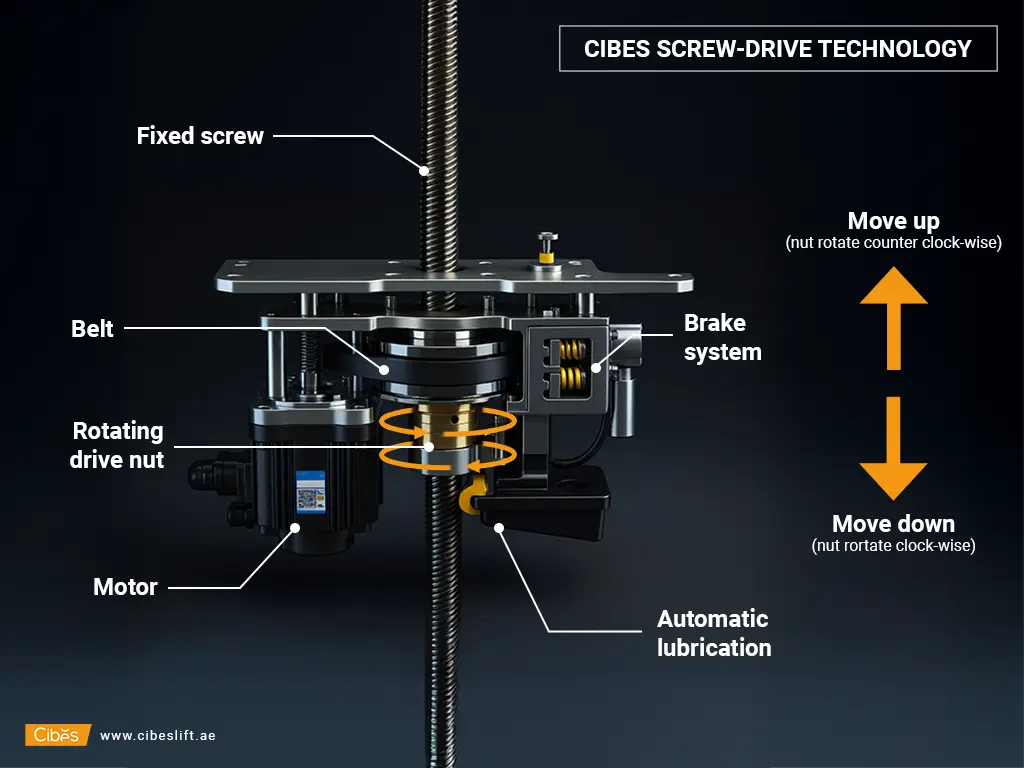
A technical diagram explaining how the Cibes screw-drive system moves the lift up and down.
What happens during a power cut?
Cibes user guidance for supported platform models describes an electric emergency-lowering function during a power failure. A passenger can use a control button to lower the lift to the nearest landing below, where the door can open for exit. Emergency lowering is slower than normal travel, and the lift remains out of service until main power returns. Exact behavior varies by model, so the installed user manual should be the handover reference.
Read the full UAE guide: Home Lift Power Backup and Outage Safety
This video shows how the emergency lowering function of a Cibes lift works during a power failure.
How often should a Cibes home lift be maintained?
Cibes Lift UAE recommends preventive maintenance twice a year (every six months) to help keep your home lift operating safely, smoothly and reliably.
Through its Annual Maintenance Contract (AMC), Cibes Lift UAE schedules regular service visits to inspect key components, check the lift’s performance, and identify potential issues before they become costly repairs.
Maintenance requirements may vary depending on the lift’s usage, operating conditions and specific service needs.
UAE service-plan detail: Home Lift Maintenance Cost in the UAE
What should UAE homeowners check before buying?
The safest choice is not a drive type in isolation. Start with who will use the lift, the number of stops, rated load and whether the product is a platform lift or cabin lift. Then check the applicable standard, door and obstruction protection, emergency-lowering method, rescue instructions and maintenance plan. A screw-and-nut system can offer a strong mechanical safety advantage, but the final decision should be based on the complete documented system and the site conditions.
| Question to ask | Why it matters |
|---|---|
| Which standard applies to this exact model? | Prevents a platform-lift standard from being presented as a universal home-elevator standard. |
| What is the rated load and usable platform or cabin size? | Confirms the lift suits the expected users and daily use. |
| What stops the lift if a door is open or something is obstructing the travel area? | Identifies the door interlocks, safety edges, light curtains or other protections. |
| What happens during a power cut? | Confirms emergency lowering, alarm or communication and the passenger exit procedure. |
| How is rescue handled if the lift stops between floors? | Makes sure occupants and family members are not expected to force doors or self-evacuate. |
| How often will this lift be serviced in this UAE installation? | Separates the manufacturer minimum from the local AMC or site-specific service plan. |
What should be kept in the handover file?
Keep the model-specific declaration or certificate, approved drawings, operation and maintenance manual, emergency-lowering or rescue instructions, maintenance contact details and service record together. These documents are more useful than a broad claim that a lift is simply “safe” or “compliant.”
- Exact model declaration, certificate or conformity documentation supplied for the installation.
- Approved drawings and the operation and maintenance manual.
- Emergency-lowering or rescue instructions, maintenance contact details and service record.
What should buyers know about Cibes screw-driven safety?
Cibes is founded by Bertil Svedberg, who developed a modern screw-driven lift system for housing adaptation during the 1970s. This history is relevant to the company’s experience with screw-and-nut lifts, but it should not be used as proof that every model is automatically safer than every competing technology. For a purchase decision, verify the exact model documentation and safety functions.
Typical Cibes platform-lift safety elements to verify on the exact model include:
- Screw-and-nut drive on Cibes platform models, with the exact configuration confirmed in model technical data.
- Door and travel-area safety devices that vary by model, such as interlocks, safety edges or light curtains.
- Emergency functions described in the model user guide, including emergency lowering on supported platform models.
- A maintenance and handover process that should include testing of safety devices and written rescue instructions.


Frequently Asked Questions (FAQ) on Home Lift Safety
Are screw-driven home lifts safer than vacuum lifts?
Both systems can be safe when they are properly designed, installed and maintained. A screw-and-nut system can have a mechanical advantage because the carrier remains engaged with the screw. Vacuum lifts use a different pressure-based system with model-specific safety devices. Compare certification, load, rescue behavior and maintenance instead of relying on drive type alone.
Does EN 81-41 apply to every home lift in the UAE?
No. EN 81-41:2024 is written for a defined category of vertical lifting platform intended for people with impaired mobility. A cabin-style home elevator may fall under a different standard or conformity route. Ask which standard applies to the exact model.
Do modern home lifts use SIL-rated electronics?
Many controllers and safety components are designed to IEC 61508 principles; you’ll see SIL ratings (often SIL 2–SIL 3) for certain safety functions or modules.
What happens in a power cut?
On supported Cibes platform models covered by the user guide, emergency lowering lets the passenger move the lift slowly to the nearest landing below and exit. The exact process differs by model, so the installed user manual should be checked during handover.
What’s the typical price range in the UAE?
AED 80,000–250,000 depending on travel, stops, model, and finishes. See Home Lift Price in UAE
Does a Cibes home lift need a machine room?
Many Cibes screw-driven models integrate the drive equipment into the lift structure and do not need a separate machine room. Pit and headroom requirements still vary by model, so check the technical drawing for the exact lift being quoted.
How often should a Cibes home lift be serviced?
Cibes global guidance gives once a year as the minimum for lightly used indoor lifts, with more visits depending on usage, environment and local requirements. Cibes Lift UAE currently schedules four preventive visits per year under its local AMC.
Who invented the modern screw-driven passenger-lift system?
Bertil Svedberg of Cibes, the company is widely recognized as the original in screw-driven passenger-lift technology.
Not sure which home lift fits your villa?
Share your floor plan with our team and get a tailored recommendation and quotation – no obligation.
About the Author