

TL;DR: Modern home elevators can be safe when correctly designed, installed, operated, and maintained. Their safety depends on several systems working together, including the drive mechanism, door protection, emergency rescue, and fault monitoring. For UAE homeowners, installation quality, high temperatures, and regular maintenance also deserve attention.
Are home elevators safe? Yes, modern home elevators are designed to carry passengers safely between floors. But that answer comes with an important condition: the lift must be suitable for its intended use, correctly installed, and maintained throughout its service life.
If you’re planning to install a home elevator, you probably have a few concerns. Could the lift fall? What happens during a power outage? What if a child blocks the door? Can your elderly parents use it independently?
These are the questions homeowners should be asking.
At Cibes Lift UAE, we work with homeowners across Dubai, Abu Dhabi, and other emirates, installing and maintaining screw-driven home lifts in private villas and other properties. Our experience has shown us that safety concerns don’t end after installation. They also involve how the lift responds to unexpected situations and how its safety systems perform years later.
In this article, we’ll explain how modern home elevator safety works, which protections are important, and what we’ve learned from operating and maintaining lifts in UAE conditions.
1. What Makes a Modern Home Elevator Safe?
A safe home elevator needs more than a strong motor and a well-built cabin.
Its safety depends on several systems working together. Some prevent dangerous movement. Others detect problems, stop the lift, or help passengers exit during an emergency.
What are the most important home elevator safety systems?
Modern home elevators may include the following protections, depending on their design and classification.
| Safety system | What it does |
| Mechanical support and braking | Supports the lift and controls or stops movement |
| Door interlocks | Prevent normal travel unless required doors are closed and locked |
| Safety edges or light curtains | Detect contact or obstructions within protected areas |
| Emergency battery system | Allows controlled emergency movement during a power failure |
| Emergency communication | Allows passengers to request assistance |
| Fault monitoring | Detects specific equipment problems and can prevent unsafe operation |
| Overload protection | Prevents normal travel when the permitted load is exceeded |
No single feature guarantees safety.
For example, a strong lifting mechanism doesn’t remove the need for reliable door locks. Similarly, a backup battery is useful only if it remains in working condition.
This is why homeowners should evaluate the complete safety system rather than comparing individual features.
Are all home elevator technologies equally safe?
Home elevators use different technologies, including screw-driven, traction, hydraulic, and pneumatic systems.
Each technology has its own way of moving and supporting the cabin. Each also requires safety devices suited to its design.
A traction elevator, for example, uses suspension and braking systems. A hydraulic elevator relies on its hydraulic lifting equipment, valves, and other protective devices. A screw-driven lift uses a threaded mechanical connection between its lifting screw and drive nut.
These differences affect how the lift operates, what can wear out, and which components require inspection.
It would be misleading to say that one technology is automatically the safest in every situation.
The better approach is to check whether the complete lift complies with the applicable standards and whether its protective systems are suitable for the people who will use it.
For a broader overview, our home lift safety guide for UAE homeowners explains the main safety features worth checking when comparing products.
2. Can a Home Elevator Fall or Move Unexpectedly?
The possibility of a lift falling is one of the most common concerns among homeowners.
Modern elevators are designed with mechanisms that prevent uncontrolled movement. But the exact method depends on the drive technology.
How does a screw-driven home elevator prevent free fall?
A screw-driven lift works differently from an elevator suspended by ropes or belts.
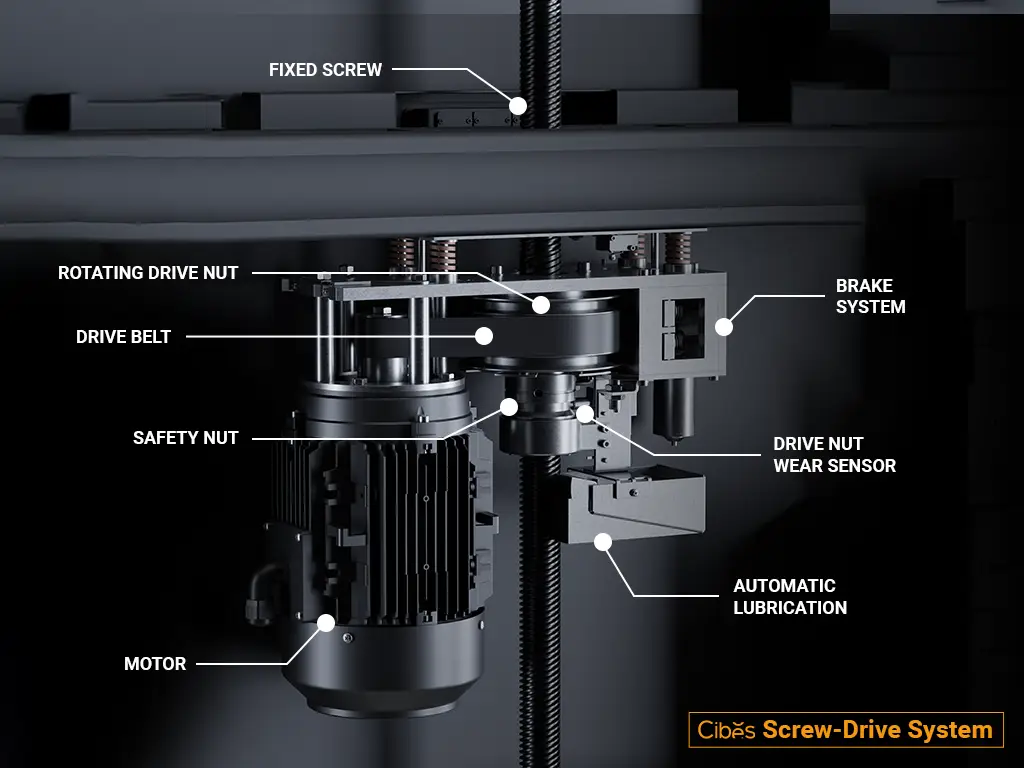
In a Cibes screw-driven lift, a fixed vertical steel screw runs along the lift’s travel path. The drive mechanism is attached to the moving platform or cabin, with a drive nut engaged around the screw.
When the motor rotates the nut, it travels upwards or downwards along the fixed screw, carrying the platform or cabin with it.
The screw and nut remain mechanically engaged during operation.
A key characteristic of the Cibes system is its self-locking screw design, which resists downward movement under the lift’s own weight when the motor is not driving it.
This provides inherent protection against uncontrolled descent caused by loss of motor power.
However, the complete safety system remains important. The drive nut, braking equipment, safety monitoring, and other components must all function correctly.
The mechanical principle is explained further in our screw-driven home lift technology guide.
What happens if the drive nut or braking system develops a fault?
Every mechanical system experiences some wear during its service life.
This is why monitoring critical components matters.
The Cibes V80 and V90 incorporate a secondary safety nut, drive nut wear monitoring, and brake monitoring.
These systems provide additional protection beyond the primary screw-and-nut drive.
If a monitored safety fault is detected, the lift displays an error and prevents normal operation until the problem is resolved.
For example, a fault related to excessive drive nut wear or the braking system should not be treated as an ordinary operating inconvenience.
The system is designed to prevent continued normal use when these monitored safety conditions are not satisfied.
This explains an important aspect of modern lift safety: sometimes, a lift refusing to move is evidence that a protective system is doing its job.
The correct response is to have the fault investigated and repaired by qualified personnel, not to bypass the system.
Both the Cibes V80 platform lift and Cibes V90 cabin lift use this screw-driven safety concept, although their passenger protection arrangements differ.
3. What Happens if a Home Elevator Loses Power or Stops Between Floors?
A power outage should not result in uncontrolled lift movement. Modern home elevators use braking and other protective mechanisms to keep the carrier stationary when normal power is lost.
However, preventing movement is only part of the solution.
Passengers also need a safe way to exit.
Can you get out of a home elevator during a power outage?
Many modern home elevators include emergency battery systems that allow controlled movement when the main electricity supply fails.
Cibes V80 and V90 lifts are equipped with battery-backed emergency rescue functions.
When a power outage occurs, the lift stops and enters emergency battery mode.
The passenger can press a control button to activate emergency lowering. The lift then travels at reduced speed to the next landing below, where the door can open for a safe exit.
There is another protection that homeowners may not think about.
On the Cibes V80 and V90, battery condition is monitored. If the system detects a battery-related fault that affects its required emergency function, an error is displayed and normal operation is inhibited.
This helps ensure that a detected problem with the emergency rescue system is addressed before the lift returns to normal use.
What happens if the lift stops and battery rescue isn’t available?
An elevator may stop between floors because of a technical fault rather than a power outage.
In this situation, passengers should remain inside, use the emergency communication system, and follow the manufacturer’s instructions.
Cibes offers emergency communication arrangements that can include telephone and wireless systems. The V80 and V90 can also be equipped with SIM-based communication to call a configured telephone number.
If battery-powered rescue cannot be used, Cibes screw-driven lifts provide a manual emergency lowering mechanism.
This system allows trained, authorised personnel to lower the lift using a dedicated crank tool.
Passengers should not attempt to open the landing door while the lift is between floors or try to climb out through the opening.
At Cibes Lift UAE, we provide technical assistance outside normal business hours.
When a customer reports a problem, our team first assesses the situation and may provide remote guidance while arranging an on-site technician when necessary. This is particularly useful for installations located farther from our service centres.
Remote troubleshooting cannot resolve every fault, and rescue procedures must always follow the instructions for the installed model.
For homeowners, the important question is not simply whether the elevator has an alarm.
You should also know who receives the emergency call, how the rescue system works, and who is authorised to assist you.
4. Are Home Elevators Safe for Children, Elderly Parents, and Everyday Use?
A home elevator may be used by several family members throughout the day.
Children may use it to reach their bedrooms. Elderly parents may rely on it to avoid stairs. Other family members may carry luggage, shopping bags, or household items between floors.
This makes door protection, passenger detection, and overload monitoring particularly important.
What prevents children or passengers from being injured by the doors?
Modern home elevators use door interlocks to prevent normal operation when required doors are not secured.
On Cibes home lifts, the landing door must be fully closed and locked before the lift can move.
If a required door lock disengages or the system detects an unsafe door condition during travel, the lift stops.
Automatic door configurations also incorporate obstruction protection.
If a powered Cibes door detects an obstruction while closing, the door reopens and attempts to close again.
Manually operated doors require a different approach. They should be opened within their permitted range and should never be forced.
Why do door clearances matter?
The US Consumer Product Safety Commission documented serious child entrapment hazards involving excessive gaps between residential elevator landing doors and inner cabin doors.
In September 2022, the agency reported that recalls addressing this hazard had reached 117,100 residential elevator units across the United States during 2021 and 2022.
These recalls concerned specific elevator products and are not evidence of defects in Cibes lifts or a measure of incidents in the UAE.
They do, however, demonstrate why door clearances, protective systems, and correct installation are essential.
Homeowners can read the US Consumer Product Safety Commission’s residential elevator safety findings.
How do safety edges, light curtains, and overload protection work?
Modern home elevators use sensors to detect certain obstructions or unsafe operating conditions.
The Cibes V80 platform lift uses mechanical safety edges. If a safety edge is activated during travel, the lift stops immediately.
The Cibes V90 cabin lift uses light curtain protection. When an obstruction interrupts the protected area during movement, the lift stops.
These systems reduce the risk of injury, but they only provide protection within their designed detection areas.
Homeowners should still teach children not to touch moving parts, block entrances, or play around the lift.
Overload protection provides another important safeguard.
If passengers or objects exceed the permitted load, the Cibes lift refuses to operate. A continuous audible warning sounds, and models with compatible displays also show an overload error.
The lift can resume normal operation only after the excess load is removed and the overload condition clears.
For elderly users and wheelchair users, safety also involves choosing suitable dimensions, accessible controls, and doors that can be operated comfortably.
A lift can have effective safety systems and still be unsuitable for someone if its usable space or entrance arrangement doesn’t meet their needs.
5. How Do UAE Climate, Installation, and Maintenance Affect Home Elevator Safety?
Even a well-engineered home elevator requires proper installation and regular care.
For UAE homeowners, outdoor temperatures, dust, humidity, electrical supply conditions, and daily usage deserve particular attention.
What have we learned from maintaining home elevators in the UAE?
From our experience maintaining Cibes home lifts across the UAE, battery condition is one of the areas that requires particular attention, especially in outdoor installations.
High temperatures can affect battery service life and the performance of sensitive electrical equipment.
For context, the UAE National Centre of Meteorology recorded an outdoor temperature of 49.8°C in Saih Al Salem, Dubai, on 15 July 2025, as reported by Aletihad.
That reading doesn’t represent the temperature inside a lift shaft, but it illustrates why outdoor lift installations require proper heat assessment.
During our preventive maintenance visits, technicians check battery voltage and condition. Batteries showing signs of deterioration are assessed for replacement.
We’ve also encountered electrical component faults associated with problems in a property’s electrical supply. These can affect circuit boards and require technical inspection.
For outdoor installations, we assess the location before recommending a lift configuration.
Depending on the expected sunlight exposure and shaft temperature, the design may require ventilation, tinted glazing, solid shaft panels, or a separate air-conditioning system.
Some Cibes models also incorporate fans and monitored temperature protection.
Importantly, the standard Cibes outdoor lift concept has published operating temperature limits of approximately -10°C to +30°C. Additional temperature-control measures must be considered for hotter environments.
An outdoor-rated lift should never be assumed suitable for every UAE installation without checking its specific operating limits.
We’ve also observed avoidable problems related to how homeowners use and maintain their lifts.
One example is switching off the lift’s electrical supply before leaving for a long holiday.
This may interrupt normal battery charging. If the batteries become deeply discharged, the emergency system may no longer be ready for use until the issue is addressed.
Unless an emergency or authorised technician requires otherwise, homeowners should keep the lift’s designated power supply connected.
Other preventable issues include forcing automatic doors, opening manual swing doors beyond their permitted angle, poor cleaning, and missing scheduled service visits.
These may appear to be minor habits, but proper use helps protect both the lift’s mechanical components and its safety devices.
How do we verify safety during installation and maintenance?
Before a new lift is handed over, its safety functions must be checked and tested.
At Cibes Lift UAE, our installation team checks the lift’s operating systems, safety devices, emergency functions, door protection, and overload detection.
We also carry out passenger travel tests during handover.
Additional load testing is arranged according to the lift model, applicable project requirements, or third-party inspection needs. Load testing is also part of our commercial installation practice.
During handover, we explain the emergency functions, safe operating procedures, and appropriate reset instructions to the homeowner.
This is important because understanding what to do during a fault is part of using a home elevator safely.
For a detailed overview of site preparation and commissioning, see our home lift installation guide for the UAE.
Safety checks don’t stop after handover.
Under normal conditions, some Cibes screw-driven home lifts may require only one or two scheduled maintenance visits per year, depending on use and the manufacturer’s requirements.
In the UAE, we schedule four preventive maintenance visits annually as part of our local maintenance service.
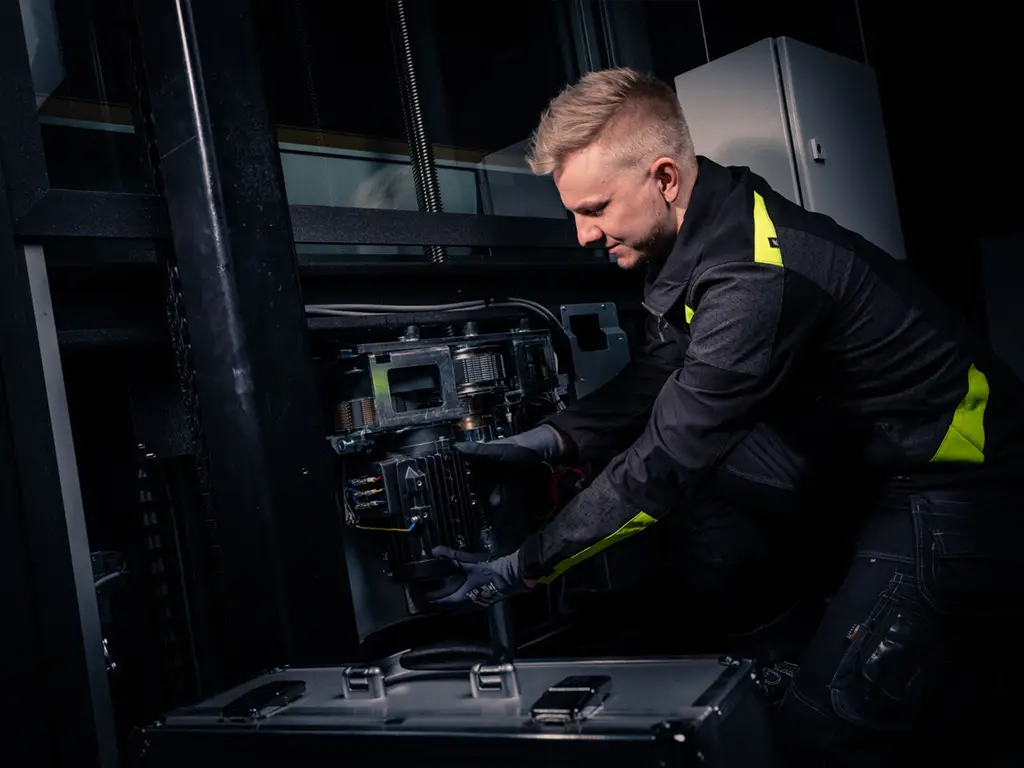
These visits include inspecting the drive system, checking lubrication, testing door protection and safety devices, reviewing battery condition, and checking emergency lowering and communication functions.
More frequent inspections do not guarantee that a lift will never experience a fault. They provide regular opportunities to identify wear, deterioration, and potential problems before they become more serious.
Our home lift maintenance guide explains the key maintenance areas and typical service arrangements for homeowners.
Which safety standards should homeowners check?
European standards provide a useful reference when evaluating home lift safety, but the correct standard depends on the type of lift.
One commonly referenced standard is EN 81-41:2024.
It covers a defined category of electrically powered vertical lifting platforms intended for people with impaired mobility. Its scope includes several drive technologies, including screw-and-nut systems, and platforms with rated speeds not exceeding 0.15 m/s.
It does not automatically apply to every fully enclosed home elevator.
The Swedish Institute for Standards provides the official scope of EN 81-41:2024.
Different lift types may have different applicable standards and conformity requirements.
For our Cibes models, factory production follows the relevant type-certification and quality control processes. Components and drive movements undergo production checks, while completed installations receive commissioning tests.
Homeowners can request model-specific conformity documentation, applicable certificates, and handover records.
In the UAE, any applicable building approvals and inspection requirements should also be confirmed for the actual project.
You can read our detailed EN 81-41 safety standard guide for a clearer explanation of what the standard covers.
Before choosing any home elevator, we recommend confirming five things:
- The safety standards and certification applicable to the exact model.
- How the lift is supported, stopped, and protected against mechanical faults.
- What happens during power failures, door obstructions, and emergency situations.
- Which tests and documents are provided at handover.
- Who provides ongoing maintenance, replacement parts, and emergency assistance.
These checks are more useful than relying on general promises that a particular elevator is completely safe.
Frequently Asked Questions About Home Elevator Safety
Are home elevators safe for elderly people?
Yes, a properly designed and maintained home elevator can provide safe access between floors for elderly family members. The lift should have suitable dimensions, accessible controls, secure doors, and emergency communication. The user’s mobility and ability to operate the lift independently should also be considered.
Can a home elevator fall during a power outage?
A correctly designed home elevator should not fall when electricity is interrupted. Its mechanical support and braking systems are designed to prevent uncontrolled movement. Cibes screw-driven lifts use an engaged screw-and-nut mechanism, with emergency battery lowering available for power failures.
Can children safely use a home elevator?
Modern home elevators include protective devices such as door interlocks, obstruction sensors, safety edges, or light curtains, depending on the model. However, children should be taught safe operating practices, and younger children should be supervised.
What should I do if my home elevator gets stuck?
Remain inside and use the emergency communication system. Follow the manufacturer’s instructions and contact the designated service provider. Do not force the doors or attempt to leave between floors. If battery-powered emergency lowering cannot be used, trained personnel should perform the rescue.
How often should home elevators be maintained in the UAE?
The required frequency depends on the lift model, usage, operating environment, and applicable requirements. Some residential screw-driven lifts may need one or two routine visits per year under normal conditions. Cibes Lift UAE schedules four preventive maintenance visits annually under its local service program.
Are outdoor home elevators safe in Dubai and Abu Dhabi?
Yes, outdoor home elevators can be suitable for UAE properties when their design and installation account for the expected conditions. Heat, solar exposure, dust, humidity, and corrosion protection need careful assessment. The lift’s operating temperature range and any additional cooling requirements should be confirmed before installation.
Final Thoughts: Home Elevator Safety Is About More Than One Component
A home elevator’s safety should never depend on a single mechanical component or electronic device.
The lifting mechanism must support the cabin. Backup systems should provide protection against relevant failures. Sensors and monitoring devices must detect unsafe conditions. Emergency systems must help passengers when normal operation is interrupted.
Just as importantly, these systems need to remain in good working condition throughout the lift’s life.
For UAE homeowners, this makes installation quality, environmental suitability, maintenance, and access to technical support essential considerations.
At Cibes Lift UAE, as a direct subsidiary of Sweden-based Cibes Lift Group, we provide home lift solutions in the UAE with direct support from product selection and installation through to long-term maintenance.
Our advice is to look beyond the design and features of a home elevator. Understand how it works, ask what protects you when something goes wrong, and make sure qualified technicians will support it throughout its service life.
A good home elevator should provide confidence not just when it’s new, but for many years of everyday use.


