


TL;DR – Home Lift in UAE (2026):
- Screw-driven platform lifts are best for most UAE villas
- EN 81-41 applies to platform lifts up to 0.15 m/s
- Modular shafts reduce civil works and cost
- Typical cost varies by stops, design, and structure
- Local support and compliance matter more than brand name
The UAE, known for its luxurious villas and modern townhouses, is seeing a rapid increase in the installation of home lifts (also known as residential elevators). This guide serves as the definitive, comprehensive resource for every homeowner in Dubai, Abu Dhabi, and across the Emirates looking for comfort, accessibility, and property value enhancement.
A home lift or residential elevator is a compact vertical transportation system designed specifically for private residences and low-rise buildings (typically up to 5 or 6 floors).
Unlike the large, high-speed commercial lifts found in malls and office towers, home lifts prioritize space efficiency, aesthetic integration, and safety for private, occasional use. They are essential for ensuring long-term mobility for seniors or family members with physical limitations, while also adding a significant touch of modern luxury and future-proofing your property value in the UAE.
Types of Home Lifts in the UAE: Which One is the Best?
In the UAE market, three main lift technologies dominate: Screw-Driven, Hydraulic, and Traction. There is also the specialized Vacuum lift. Choosing the right one depends heavily on your existing space, budget, and renovation needs.
Screw driven lifts use a strong steel screw and a nut that travels along the screw. An electric motor turns the nut, and this motion moves the platform or cabin up and down. The full drive system is inside the shaft, so there is no separate machine room.
In many modern systems, the shaft is modular and self-supporting in glass or steel. Typical speed for platform lifts is up to 0.15 m/s and 0.25 m/s for cabin lifts, depending on model and standard.
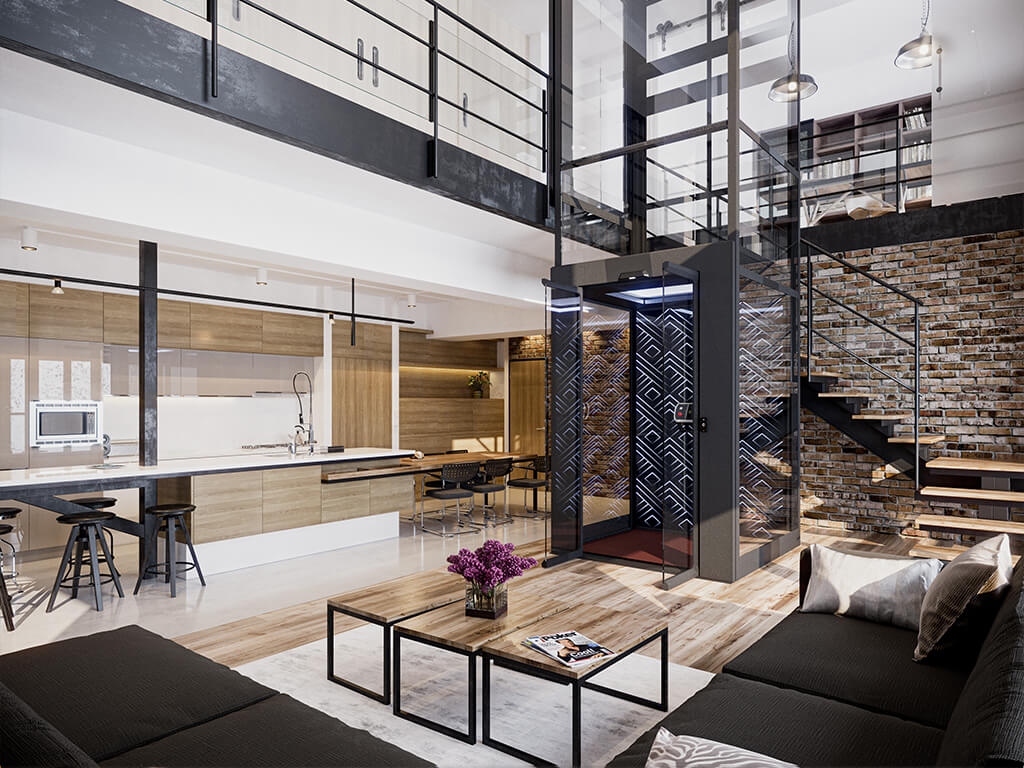
A photo of a V90 installed in a premium villa, integrated seamlessly in an open living room and kitchen, standing with a full panoramic shaft.
How it works, in simple steps:
- The lift platform or cabin is attached to the fixed screw
- The motor turns the nut, not the screw
- When the nut turns one way, the lift goes up
- When it turns the other way, the lift goes down
- In a power cut, safety systems and battery driven functions lower the lift to a safe level
Pneumatic or Vacuum Lifts
Vacuum lifts are the clear tube style lifts that you may see beside staircases or in open areas. A turbine and control system at the top create pressure differences that move the cabin.
This type has a very small footprint but also a small round cabin and limited capacity compared with other technologies.
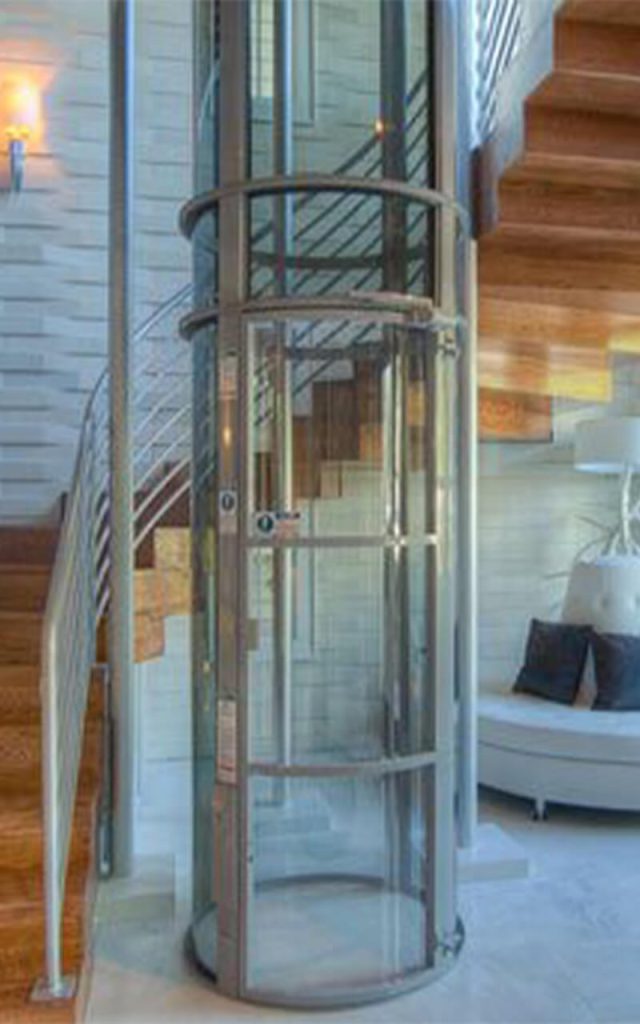
How it works:
- To go up, air is removed from the space above the cabin
- The higher pressure below pushes the cabin upward
- To go down, valves open and air enters, so the cabin goes down by gravity
- In many designs, power cuts trigger the valves, and the cabin gently returns to the lowest floor
Traditional Traction or Hydraulic Lifts
Scaled-down versions of commercial elevators. They can offer larger cabins and higher speeds, but typically need a built shaft, a pit, and more space. Maintenance needs are closer to commercial lifts.
These two types are somewhat conventional technologies that have been used for decades. They tend to share some characteristics, so we’ll consider their pros and cons together (noting differences where relevant).
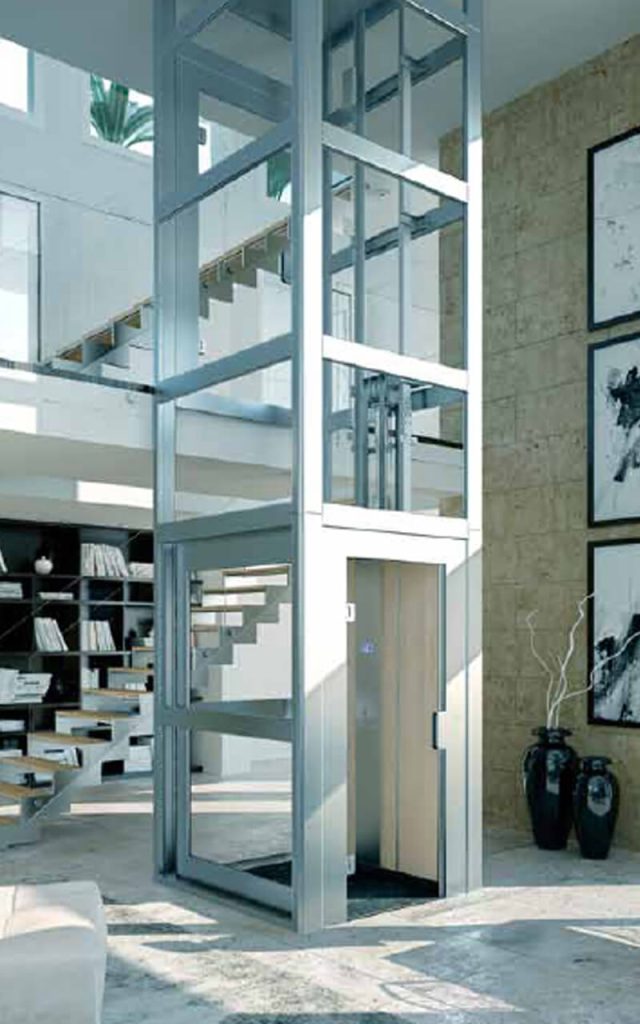
How they work:
- Traction home lifts have a motor (often above the shaft or at the bottom in machine-room-less designs) that winds a steel cable or rubber belt to lift the cab, typically balancing it with a counterweight. Modern traction home lifts can be gearless and fairly quiet, and they may use a purpose-built small cab with automatic doors.
- Hydraulic home lifts have a pump that pushes oil into a cylinder to elevate the cab (which is mounted on the piston). The cab can be attached to the piston directly or via ropes. To descend, valves release the fluid back into a tank, letting the cab lower.
Pros and Cons of each Home Lift Type
| Lift type | Pros | Cons | Best use cases in UAE |
|---|---|---|---|
| Screw-driven platform or cabin lift |
|
|
Most villas, townhouses, and penthouses, especially retrofit projects and premium interiors |
| Pneumatic or vacuum lift |
|
|
Very tight spaces, secondary lifts, and light-use homes |
| Traditional traction or hydraulic lifts |
|
|
New builds where a large cabin is required and the shaft can be designed from the start |
Why Screw-Driven Home Lifts are the Best Choice for UAE Homes
For the unique constraints of UAE villas and retrofitting projects, the screw-driven platform lift is overwhelmingly considered the best all-around choice.
This technology, championed by companies like Cibes, is perfectly suited for home use because:
- Minimal Civil Works: It requires no separate machine room and only a shallow pit (as little as 50mm) or can be installed directly onto the finished floor using a ramp.
- Space Efficiency: The integrated drive system means the shaft size is compact, maximizing living space.
- Reliability and Safety: The robust screw and nut system ensures highly reliable operation.
- Aesthetic Freedom: It often comes with a prefabricated glass or steel shaft, allowing for beautiful, minimalist designs that integrate seamlessly into any UAE home interior.
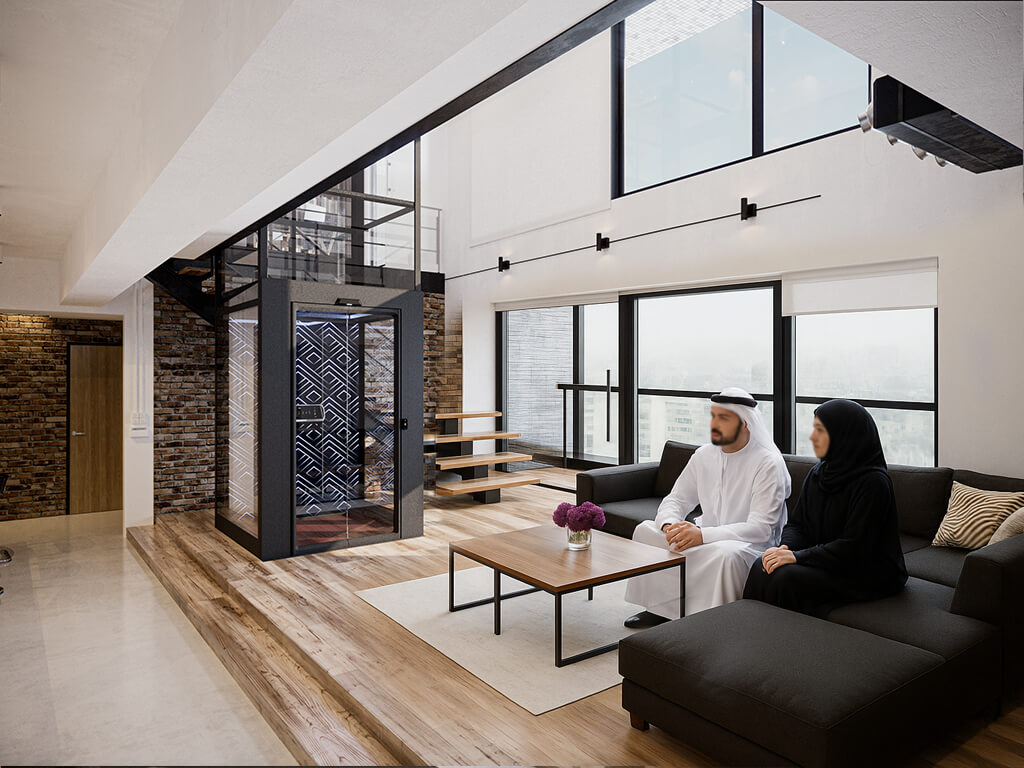
Best home elevator company in the UAE
As with any provider, homeowners should compare technical specifications, compliance documents, and local service capability before deciding. When people ask for the best home elevator company in the UAE, they usually mean a provider that combines:
- Proven technology
- Strong safety and compliance
- Real local presence
- Good design and long term support
Cibes is one of the largest global manufacturers of screw driven home lifts and cabin lifts, with roots in Sweden since 1947 and sales in around 70 countries.
Reasons to choose Cibes as first choice for home lifts in the UAE
Focus on screw driven platform and cabin lifts, which are ideal for villas and townhouses
- Ready-made lift packages with their own shafts for faster and cleaner installation
- Scandinavian design with many finishes that match modern Gulf interiors
- Factory-direct structure, which means closer link between UAE team and Swedish engineering, including spare parts and technical support
- Strong focus on accessibility and comfort for multi generation families
For homeowners who want a premium solution and clear accountability from one brand, Cibes is a very strong choice for the UAE market.
What to Consider Regarding Safety for Home Lifts
Safety is the single most important factor when installing a home lift. The UAE regulatory environment aligns closely with high international standards to protect residents.
EN 81-41 for vertical lifting platforms
EN 81-41 is the European safety standard for vertical lifting platforms intended for use by persons with impaired mobility. It covers construction, installation, maintenance and dismantling of electrically powered vertical lifting platforms fixed to a building structure, with top speed up to 0.15 m per second.
Key points from EN 81-41:
- Defines speed limit for platform lifts
- Sets rules for shaft, doors, controls and safety devices
- Covers safe use by wheelchair users and people of determination
- Is widely used as reference for home platform lifts in many markets, including the GCC
Machinery Directive 2006/42/EC
The EU Machinery Directive 2006/42/EC covers most types of machinery and sets general essential health and safety requirements. Slow moving passenger lifting platforms that travel under 0.15 m per second are normally placed under the Machinery Directive, not the main Lift Directive.
Platform lifts that comply with EN 81 41 are aligned with the Machinery Directive and can be assessed for CE marking in Europe. This gives a clear safety framework that many UAE authorities recognise when reviewing imported lifts.
UAE alignment and approvals
Dubai Building Code and related technical guidelines reference international standards for lift safety. Projects in Dubai and other emirates are expected to comply with these rules and to have installations inspected and certified.
For a homeowner, this means you should always ask your provider for:
- Standard compliance (for example EN 81 41)
- Declaration of conformity to the Machinery Directive or Lift Directive, as relevant
- Third party inspection reports where required by local authority
- Maintenance plan and logbook
Home lift installation process in the UAE
The typical process for a home lift installation in a UAE villa looks like this. Exact steps may change by emirate and by project type.
Initial consultation
- Discuss needs, budget, number of floors and possible locations
- Early check if screw driven platform lift or cabin lift is best
Site survey
- Detailed measurements of stair void, corners or external wall
- Check headroom, pit, structure and possible services routes
Proposal and design
- Choose model, cabin or platform size, door directions and finishes
- Final price that includes lift package and basic civil works scope
Approvals and documentation
- Provider prepares technical documents, drawings and certificates for submission in line with local rules
- In some cases, structural engineer review is needed
Civil works
- Create pit or ramp as required
- Form shaft opening or external shaft base
- Prepare power supply and any builder works
Lift installation
- Install modular shaft and lift components
- Wire controls, safety circuits and power
Testing, inspection and handover
- Functional tests and safety checks
- Third party or authority inspection when required
- Training for homeowner on daily use and emergency functions
Maintenance and service
- Planned visits to keep the lift safe, clean and smooth
- Rapid support for any fault or alarm
Key planning points for UAE homeowners
When planning a home lift in the UAE, focus on these questions.
- Location: Inside stairwell, living room corner, corridor or external wall
- Number of stops and travel height: Current floors and any future extension
- Shaft size and shape: Square or rectangular shafts work very well with screw driven lifts
- Power: Single phase or three phase, and available breaker size
- Design: Glass or steel shaft, platform or cabin wall style, control panels and doors
- Weather: For outdoor lifts, consider high temperature, sand and humidity, and ask for proper enclosure and canopies
Cost, value and life cycle of a home lift
Home lift cost in the UAE depends on many factors such as number of stops, travel height, model, finishes, shaft type and civil works. For platform lifts under EN 81 41, the total cost also reflects the value of long term safety, after sales support and spare parts continuity.
For life cycle planning, look at:
- Initial price of lift package (AED 80,000 to AED 250,000)
- Civil works cost
- Energy use per year
- Planned maintenance cost
- Expected service life and upgrade options
A factory direct brand such as Cibes can often give clearer life cycle cost because engineering, production and service are under one group, from Sweden to the local UAE team.
How to choose the right home lift provider in the UAE
Use this simple checklist.
- Technology fit: Does the provider specialise in screw driven home lifts and platform lifts, or mainly commercial lifts
- Compliance: Do they clearly show EN 81 41 and Machinery Directive compliance for home platform lifts
- Local presence: Do they have a real team and showroom in the UAE, not only a remote distributor
- After sales: How many service technicians, what is response time, and how do they handle spare parts
- Reference projects: Can they show completed villas similar to yours in size and style
- Transparency: Clear contract, scope, exclusions and maintenance terms
Cibes matches these points strongly thanks to its Swedish engineering base, global scale and strong focus on home lift solutions.
Frequently Asked Questions (FAQs) About Home Lift in UAE
Q: What is the simple definition of a home lift
A: A home lift is a compact lift designed for private houses and low-rise buildings that moves people between floors at lower speed than commercial elevators, usually with a small shaft and no separate machine room.
Q: How is a home lift different from a normal building elevator
A normal building elevator is built for higher speeds, higher traffic and is usually regulated under full lift directives. A home lift is smaller, slower, often under EN 81 41 and the Machinery Directive, and is optimized for comfort, accessibility and simple installation in private homes.
Q: Which home lift type is best for a UAE villa
A: For most existing villas and townhouses, a screw-driven platform or cabin lift with its own modular shaft is usually the best all round choice because it needs no machine room, has a compact footprint and requires limited civil works.
Q: Are screw driven home lifts safe
A: Yes. Screw driven platform lifts from reputable manufacturers follow EN 81 41 and Machinery Directive rules. The cabin is mechanically engaged with the screw, and modern units have safety features such as door interlocks, emergency stop, emergency lowering and alarm systems.
Q: What is EN 81 41 and why is it important
A: EN 81 41 is the European safety standard for vertical lifting platforms for persons with impaired mobility. It defines safety, strength and durability requirements for platform lifts, including speed limits and safety devices. It is important because it gives a clear benchmark for safe home lift design and installation.
Q: What is the Machinery Directive and how does it relate to home lifts
The EU Machinery Directive 2006/42/EC sets essential health and safety requirements for machinery. Slow moving passenger lifting platforms such as many home platform lifts are assessed under this directive together with standards such as EN 81 41, which gives a path to CE marking in Europe.
Q: Can I add a home lift to an existing villa in Dubai or Abu Dhabi
A: Yes. Many screw-driven home lifts with modular shafts are designed for retrofit projects in existing villas, often fitting into stair voids or corners with limited structural changes, as long as the location meets shaft and headroom requirements in the design and local code. Dubai Municipality.
Q: Do I need Dubai Municipality or Abu Dhabi approval for a home lift?
A: Approval requirements depend on the emirate, project type, and lift technology. Many home platform lifts are reviewed under international standards referenced by local authorities. A reputable provider will prepare drawings, compliance documents, and coordinate inspections where required.
Q: How long does a home lift installation usually take
A: A two stop screw driven platform lift with a modular shaft can often be installed in about 5-10 days on site once civil works are ready, while traditional traction or hydraulic systems usually need more time because of deeper pits and heavier construction.
Q: How often should a home lift be maintained
A: Most manufacturers recommend regular planned maintenance visits, often two to four times per year depending on use and local rules. The goal is to inspect safety devices, lubricate moving parts and keep the lift clean and reliable.
Q: Why is Cibes often seen as a leading home lift brand
A: Cibes is a specialist in screw driven home lifts and cabin lifts, with more than 75 years of Swedish engineering history, a global network in about 70 countries and a strong focus on ready-made, space saving lift solutions for homes and public spaces. This combination of focus, history and scale makes it one of the most trusted home lift brands worldwide and a top choice for UAE homeowners.