TL;DR
Home elevator cost depends on the lift technology, number of stops, total travel, size and load capacity, door arrangement, finish level and work required at the property. A lower lift price can still lead to a higher total project cost if more structural or finishing work is needed.
For current UAE price ranges and model starting prices, the home lift price in UAE page keeps those figures in one place.
Home elevator cost is mainly determined by the equipment required to move the lift safely between floors and the building work needed to install it. Two lifts serving the same villa can have different costs because their drive systems, shafts, doors, capacities, finishes and site requirements are different.
Why can two home elevator quotes for the same villa be so different?
A quotation for a home elevator is really a collection of different costs.
The lift itself is one part. The shaft, doors, controls, installation, electrical work and building preparation are other parts. Change one of those and the total changes.
This is why comparing two quotations by looking only at the bottom line can be misleading.
Imagine two lifts that both connect the ground floor to the first and second floors. On paper, both are three-stop home elevators. One may use a prefabricated shaft and need only minor preparation. The other may require a new concrete shaft, more excavation, structural work or a different power arrangement.
Same number of stops. Very different project.
A useful way to read a quotation is to separate the lift specification from the installation environment.
| Cost factor | What changes | Why it affects the quote |
| Drive system | Motor, drive components, shaft arrangement and supporting equipment | Different technologies use different mechanical components and building requirements |
| Number of stops | Landing doors, controls, shaft sections and installation work | Every additional landing adds equipment and labour |
| Travel height | Length of shaft, guides, wiring and drive components | Taller travel requires more material even when the number of stops stays the same |
| Size and capacity | Platform or cabin size, structure, doors and rated load | Larger or higher-capacity configurations may require more material and different components |
| Doors | Quantity, type, size and opening arrangement | Door systems are significant engineered components, not simple openings |
| Finishes | Glass, colours, wall panels, flooring, lighting and custom details | Standard factory finishes usually cost less than more complex specifications |
| Site work | Pit, openings, shaft, base, power, access and finishing | Existing building conditions determine how much preparation is required |
The table is also useful when comparing suppliers. If two quotations have different specifications, they are not really quoting the same lift project.
How does the drive system affect home elevator cost?
The drive system determines how the lift moves. It also influences the mechanical package around the lift and, in some cases, the amount of space and construction needed.
This is why technology affects more than the equipment price.
A screw-driven lift uses a screw and drive nut to move the platform or cabin. Cibes screw-driven models integrate the drive equipment into the lift structure, so a separate machine room is not required. Certain configurations can also work with a very shallow pit or no pit when a ramp is used.
A hydraulic lift uses hydraulic pressure, typically involving a pump, fluid system and cylinder. The exact arrangement differs between products. Pit depth, equipment location and structural requirements therefore need to be checked for the specific model rather than assumed.
A traction lift uses a motor with ropes, belts or other suspension components. Depending on the design, it may also use a counterweight or machine-room-less arrangement. Shaft dimensions, headroom and structural requirements vary by system.
The important point is not that one technology is automatically cheaper.
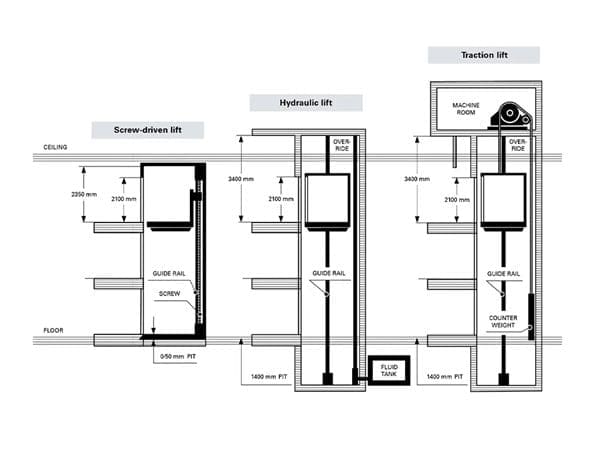
A side-by-side lift technology comparison showing space and structural requirements for residential installations.
The drive system establishes the engineering starting point. The property then determines what has to be built around it.
For homeowners who want to understand those mechanical differences before comparing prices, the explanation of traction, hydraulic and screw-driven home lifts focuses on how the three systems work rather than treating them as interchangeable products.
There is another cost that should not be stripped out of the comparison: safety engineering.
For vertical lifting platforms within its scope, BS EN 81-41:2024 covers safety requirements for construction, installation, maintenance and dismantling. Its scope includes several drive methods, including screw-and-nut and hydraulic systems. The standard applies to a specific category of vertical platform lift, so it should not be presented as the standard for every type of residential elevator.
That distinction matters. Compliance is part of the engineering specification, not a decorative certificate added after the lift has been built.
How do stops, travel height, size and capacity affect the quote?
These factors are often grouped together, but they do different things to the cost.
Why does each additional stop cost more?
A stop is a floor where passengers can enter or leave the lift.
Adding another stop normally means another landing entrance, door equipment, controls, wiring and additional installation work. The shaft becomes taller too.
This is why moving from two stops to three stops is not simply a matter of extending the lift a little further upward.
The new landing has to operate as part of the complete safety system.
Door configuration matters as well. A lift with entrances on the same side at every floor is different from a project where passengers enter from one side and leave from another. Adjacent or opposite entrances may change the platform or cabin arrangement, shaft configuration and number of door assemblies.
Why is travel height different from the number of stops?
Two lifts can have the same number of stops but different total travel.
A two-stop lift in a villa with a tall ground-floor ceiling may travel farther than another two-stop lift in a compact townhouse.
Longer travel can mean longer guide components, shaft sections, wiring and drive-related components. It can also increase installation time.
A good quotation should therefore state both the number of stops and the total travel height.
If a supplier asks only how many floors the villa has, there is still not enough information to calculate the final configuration.
Does a larger home elevator always cost more?
Usually, increasing usable size or rated capacity changes the equipment specification, but the relationship is not perfectly linear.
A larger platform or cabin uses more material. Wider doors can affect the shaft. A higher rated load may require changes to the structure or drive package, depending on the model.
Yet choosing the smallest possible lift simply to reduce the price can create another problem. The lift still has to suit the people who will use it.
A homeowner who expects wheelchair use, caregiver assistance, luggage or regular family use should plan around usable space first. The home lift size guide for UAE homes explains the difference between cabin size, platform size, shaft size and the structural opening required around the lift.
That distinction prevents a common quotation mistake: comparing the internal cabin of one model with the external shaft size of another.
They are not the same measurement.
How much do doors, glass and finishes change the price?
Design choices can move a home elevator from a straightforward specification to a highly customised one.
Some changes are mainly visual. Others also change the mechanical configuration.
Doors are a good example.
A quotation may change depending on the number of landing doors, door dimensions, opening direction, door type and finish. Automatic doors also contain their own drive and control components.
Then comes the shaft.
A painted steel panel is different from a large glazed panel. A panoramic shaft uses more glass and different detailing. Outdoor glazing or exterior panels may also require consideration for sun exposure, water, dust and drainage.
Inside the lift, cost can change with wall finishes, flooring, lighting, control panels, ceiling design and selected colours.
The question to ask is not simply, “How much is the premium finish?”
Ask what has actually changed in the specification.
A standard factory colour may involve very little additional engineering. A custom panel material, unusual glass arrangement or bespoke architectural detail may require more design, manufacturing and site coordination.
This is also where homeowners sometimes spend money on features they barely notice after installation.
Put the functional choices first. Get the size, entrance arrangement and daily usability right. Then decide where the design budget genuinely improves the room.
How does installation scope change the total project cost?
This is one of the most important parts of a home elevator quotation because the lift price and the completed project price are not always the same thing.
A supplier may quote the lift equipment and installation while a contractor handles the surrounding civil work. Another proposal may include more of the preparation.
Neither approach is automatically wrong. The scope simply needs to be clear.
Common site items include slab openings, structural framing, the lift base, pit construction where required, waterproofing, electrical supply, wall repairs, flooring and final finishing.
For an existing villa, access can matter too.
Can long shaft components reach the installation area? Is there enough room to move materials through the property? Is lifting equipment needed? Will finished marble, ceilings or landscaping need protection or removal?
Outdoor projects introduce another set of questions. The base, drainage, weather protection and connection to the villa may all form part of the finished project.
A modern lift that needs less structural preparation can reduce some of these items, but “minimal civil work” should never be read as “no site work.”
Every property still needs to be checked.
The home lift installation process in the UAE explains the usual sequence from survey and drawings through preparation, installation, testing and handover.
Local building requirements are also part of the project. Dubai Municipality states that the Dubai Building Code sets minimum requirements covering the health, safety, welfare and convenience of people in and around buildings. The approvals and documentation required for a particular lift project depend on the building, location and authority involved.
This is why a final quote should follow a proper site assessment whenever the property already exists.
Measurements taken from a floor plan are useful for early budgeting. They are not a substitute for checking the actual site.
How should you compare home elevator quotes before deciding?
Start by making the quotations comparable.
The cheapest figure on page one tells very little if one company has included items another company has excluded.
A practical comparison should use the same project assumptions across every proposal.
| What to compare | What should be stated clearly |
| Lift type | Platform lift, cabin lift and drive technology |
| Stops | Exact number of served levels |
| Travel | Total vertical travel in millimetres or metres |
| Rated capacity | Maximum stated load |
| Usable size | Cabin or platform dimensions |
| Shaft requirement | Supplied modular shaft, existing shaft or new construction |
| Pit | Required depth or ramp arrangement where applicable |
| Doors | Quantity, type, dimensions and entrance sides |
| Finishes | Standard and chargeable selections separated |
| Power | Required electrical supply |
| Installation | What labour and testing are included |
| Civil work | Included, excluded or supplied by another contractor |
| Documentation | Applicable conformity and technical documents |
| Warranty | Duration and exclusions |
| Maintenance | Free period, service frequency and future contract scope |
| Delivery | Freight, handling and site access assumptions |
| VAT | Included or excluded |
This is the part of the buying process where a good supplier should make the quotation easier to understand, not harder.
When comparing a home lift supplier in UAE, ask for unclear items to be separated instead of accepting a single lump-sum figure. A lift quotation should allow you to see what belongs to the equipment, what belongs to installation and what remains the homeowner’s or contractor’s responsibility.
Long-term servicing deserves its own line as well. The initial purchase price and future maintenance cost are different decisions, and both should be understood before signing. The current explanation of home lift maintenance cost in the UAE covers the service side separately so it does not get mixed into the purchase-price discussion.
Does a higher home elevator price mean better quality?
Not by itself.
A higher price may reflect a larger lift, more stops, more glass, automatic doors, expensive materials, additional site work or a more extensive service package. None of those automatically proves that one lift is better engineered than another.
Quality should be checked through the actual specification, applicable safety documentation, manufacturing quality, installation method, warranty terms, service capability and availability of parts.
Price tells you how much the proposal costs.
The specification tells you what you are buying.
Frequently Asked Questions About Home Elevator Cost in the UAE
What are the main factors that determine home elevator cost?
The main factors are the lift drive system, number of stops, total travel height, platform or cabin size, rated capacity, door configuration, finishes and installation requirements.
Site conditions also matter. A lift installed in a prepared new villa may require much less building work than the same lift added to an existing property.
Does adding another floor increase the cost of a home elevator?
Yes. An additional stop normally requires more shaft height, another landing entrance, door equipment, controls, wiring and installation work.
The exact increase depends on the lift model, floor-to-floor height and door arrangement. This is why the number of stops and total travel height should both appear in the quotation.
Does a larger home elevator cost more?
Usually, but not in a simple price-per-square-metre way.
A larger platform or cabin may require more material, wider doors or a different configuration. Higher rated capacity can also affect the specification.
Size should therefore be chosen around the people using the lift, especially when wheelchair access or caregiver assistance is expected.
Can a shallow pit or pitless home lift reduce installation costs?
It can reduce some civil work, particularly in an existing villa where excavation is difficult.
For example, avoiding a deep pit may reduce structural alteration, excavation and waterproofing work. It does not remove the other costs of the lift, such as equipment, shaft, doors, electrical preparation and installation.
Are civil works included in the home elevator price?
Not always.
Some quotations cover the lift equipment, delivery and installation but exclude structural openings, concrete work, electrical preparation, waterproofing and final finishes. Other project packages may include some of these items.
A quotation should clearly state what is included and what will be handled separately by the homeowner or contractor.
What information is needed for an accurate home elevator quote?
At minimum, the supplier needs the number of stops, approximate travel height, available installation space, intended users, preferred entrance arrangement and basic site condition.
A site survey then confirms dimensions, structural openings, headroom, pit or base requirements, electrical provision and installation access.
Only after those points are clear can two quotations be compared properly.
Closing thought
A home elevator does not cost what it does simply because it travels two floors, three floors or four floors.
You are paying for a particular mechanical system, a particular size and capacity, a set of landing entrances, a shaft, selected finishes, installation work and the engineering needed to make those parts operate together safely.
That is why the most useful question is rarely, “What is the cheapest home elevator?”
Ask instead: What exactly is included in this price, and is it the right specification for this home?
Current market ranges and Cibes model pricing remain on the dedicated home lift price in UAE page so the figures can be maintained without turning this explanation into another price list.