Quick Answer
A lower-priced home elevator is not automatically a poor product, and a higher price does not guarantee quality. The safest comparison checks what each quotation includes, which standards apply, who will install and maintain the lift, and whether the product suits the property for years to come.
Home elevator quotations in the UAE can vary by tens of thousands of dirhams, even when two lifts look similar in photographs. One supplier may offer a basic two-stop system. Another may include a complete shaft, upgraded doors, drawings, installation, testing, warranty, and local service.
Both quotations may be genuine. They are simply not the same scope.
The goal is not to avoid every low-priced lift. It is to understand why it costs less and whether those differences matter for your home.
What does “cheap” mean in a home elevator quotation?
Cheap may describe a simple lift with limited finishes. It may mean a smaller platform, fewer doors, a shorter warranty, or a supply-only quotation. It can also mean that the supplier has reduced its margin without reducing product quality.
That is why price alone tells you very little.
Home lift prices in the UAE cover a broad range. Stops, travel height, drive system, size, shaft type, door arrangement, finishes, site access, and installation scope all affect the final amount.
Compare the complete project, not the headline figure
Ask each supplier to separate the quotation into clear sections:
| Cost area | What should be stated clearly |
| Lift equipment | Model, drive system, load, speed, stops, travel, and clear size |
| Shaft and doors | Shaft material, glazing, number of doors, and door type |
| Installation | Delivery, assembly, testing, commissioning, and handover |
| Site work | Pit, slab opening, steel, waterproofing, power, and finishing |
| Documentation | Drawings, load data, certificates, manuals, and approval support |
| After-sales | Warranty, free service, maintenance, response time, and parts support |
A proposal that leaves these points open is difficult to compare.
Be careful with phrases such as “standard civil work.” Ask for dimensions, exclusions, and who will repair surrounding finishes.
For existing villas, confirm whether the price assumes easy access. Narrow entrances, roof access, crane lifting, or work inside a finished stairwell can change the cost.
Which quality checks matter more than brand claims?
Words such as premium, European, safe, and advanced appear in many brochures. They sound reassuring, but they are not specifications.
A proper quality review focuses on evidence.
Ask for the exact standard and certificate
The supplier should identify the standard used for the proposed lift, not simply say it follows “international standards.” Different lift categories can fall under different requirements.

Many low-speed vertical platform lifts are designed around EN 81-41 and the European machinery framework. Conventional passenger lifts may follow other parts of the EN 81 series. The correct standard depends on the product category and application.
Ask for the declaration of conformity, technical data sheet, test information, and operating manual for the exact model. The European Machinery Directive sets essential health and safety requirements for machinery, including equipment intended to lift people. EUR-Lex publishes the full directive.
For Dubai projects, the design must also fit the local building and accessibility context. Dubai Municipality states that the Dubai Building Code sets minimum requirements for health, safety, welfare, and convenience.
Certificates do not replace good installation, but they provide a clear basis for review.
Confirm the safety functions in your configuration
Do not accept a safety list copied from a general brochure. Confirm which features are included in your lift.
Checks may include door interlocks, safety edges or light curtains, emergency stop, alarm, battery-powered emergency lowering, landing protection, and a safe passenger-release procedure. The exact system differs between platform and cabin lifts. What matters is that the supplier explains how each risk is managed.
The home elevator safety information for UAE projects provides a more detailed safety checklist without turning this price comparison into a separate safety guide.

How can you judge build quality before installation?
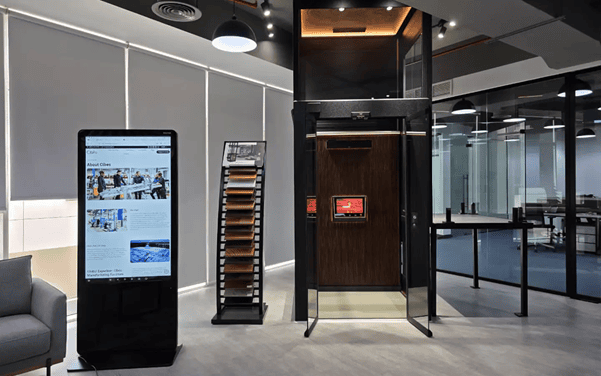
A showroom visit or reference installation can reveal details that are hard to judge from renderings and drawings.
Use the lift as a normal passenger would
Open and close the doors several times. Listen to the door movement and drive noise. Check whether panels feel secure, joints are even, buttons are easy to use, and the platform or cabin starts and stops smoothly.
Look closely at door handles, control panels, floor edges, lighting, seals, and landing frames. These details often show whether the lift was designed as a complete system or assembled from loosely matched parts.
For outdoor installations, ask how the supplier handles heat, dust, rainwater, corrosion, roof drainage, sealed controls, and electrical protection. An indoor product does not become an outdoor lift simply because it has a glass shaft.
Review the technical drawings early
A quality proposal should make coordination easier, not leave the architect guessing.
The drawings should show shaft size, clear internal size, pit or ramp, top height, landing openings, door handing, structural reactions, fixing points, power, and installation access.
This matters in UAE villas where the lift may sit inside a staircase, beside a void, against an external wall, or between finished joinery. Small errors can affect marble, ceilings, balustrades, doors, and services.
What will the lift cost after handover?
A home lift needs planned maintenance, trained technicians, replacement parts, and occasional repairs.
A low purchase price can offer good value when service is clear and parts remain available. A costly lift can offer poor value when support is weak.
Ask for a five-year ownership estimate
Request an estimate covering planned maintenance, service visits, call-out charges, common wear parts, battery replacement, labour outside warranty, and expected parts lead times.
Cibes Lift UAE states that its annual maintenance contract normally ranges from AED 4,500 after the free maintenance period, depending on the model, stops, and location. Its home lift maintenance cost guide explains what an AMC should cover.
Other products may cost less or more to maintain. Compare the contract coverage and whether the company has trained local technicians, not only the annual fee.
Read the warranty, not just its length
A five-year headline warranty can be weaker than a clear two-year manufacturer warranty if it excludes labour, travel, electronics, doors, or wear components.
Ask who provides the warranty. Is it the manufacturer, distributor, or contractor? What happens if the dealer changes? Does the warranty require a specific maintenance contract?
Cibes states that its lifts include a two-year manufacturer’s warranty covering faults linked to the manufacturing process, with an option to extend it.
Why can a higher-quality lift cost more?
A well-engineered home lift may cost more because the manufacturer invests in product testing, documented components, consistent production, safety systems, finish quality, technical support, and parts supply.
You may also be paying for a better fit.
A compact lift that avoids a deep pit, separate machine room, or large concrete shaft can reduce disruption and preserve floor area.
A modular system may also shorten installation once the site is ready. These benefits should be assessed against the full construction scope, not the lift package alone.

The home lift installation process in the UAE explains how survey, drawings, site preparation, delivery, assembly, testing, and handover connect.
Why does Cibes belong in a quality-focused comparison?
Cibes is not normally positioned as the lowest-priced home elevator in the UAE. Its case is based on product quality and long-term support rather than the cheapest entry figure.
Cibes Lift Group is a Swedish manufacturer founded in 1947 and specialises in screw-driven lift solutions. In the UAE, Cibes operates through a direct local subsidiary rather than only supplying equipment through an independent reseller.
It offers modular platform and cabin lifts, manufacturer documentation, local installation and service, and a two-year manufacturer warranty.
Its screw-driven systems integrate the drive within the lift structure, so many residential configurations do not need a separate machine room or deep pit. The range includes multiple sizes, door arrangements, shaft finishes, and platform or cabin designs.
Cibes is not the automatic answer for every project. A conventional passenger lift may suit a larger property with higher speed or traffic requirements.
Cibes becomes a strong option when the owner values compact planning, documented European engineering, design choice, direct manufacturer support, and clear responsibility after handover.
Visit the Cibes Lift UAE showroom and experience our demo home lifts before making your decision
What should you ask before choosing a home elevator?
Use the same questions for every supplier:
- What is the exact model and drive system?
- Which safety standard applies?
- Can you provide the conformity declaration and technical data?
- What are the clear internal dimensions?
- What does the quotation exclude?
- Who completes civil, electrical, waterproofing, and finishing work?
- Who installs and commissions the lift?
- Who holds the warranty?
- Who will maintain it in the UAE?
- Are technicians and common parts available locally?
- What is the estimated five-year service cost?
- Can I inspect a showroom unit or completed installation?
A supplier that answers clearly is giving you something valuable before the order is signed: accountability.
Frequently asked questions about cheap and quality home elevators
Is the cheapest home elevator unsafe?
Not necessarily. A lower price may come from a basic specification, fewer finishes, shorter travel, or a smaller scope. Judge safety through the applicable standard, documents, included safety functions, installation, testing, and maintenance support.
Why do similar-looking home lifts have different prices?
The drive system, clear size, doors, finishes, travel, warranty, installation scope, civil work, and local service may all differ. Photographs rarely show these differences.
Should I compare price per stop?
Only as a rough reference. Travel height, doors, shaft design, size, access, and structural work can affect cost as much as the number of stops.
Is a longer warranty always better?
No. Check who issues it, what it covers, which parts are excluded, whether labour and travel are included, and whether paid maintenance is required.
What should an architect request?
Request dimensioned drawings, structural loads, fixing details, power requirements, pit and headroom information, door details, certificates, finishes, installation access, and a responsibility schedule.
When is paying more worthwhile?
It makes sense when the extra cost brings measurable benefits such as better documentation, stronger space use, suitable safety systems, improved finishes, reliable local service, parts support, or less civil work.


The final decision is about risk, not price alone
A good-value home elevator is not always the cheapest or the most expensive. It is the lift that meets the property’s needs, arrives with a complete scope, follows the right technical requirements, and has dependable support after installation.
Compare evidence. Ask awkward questions. Put exclusions in writing.
That protects the homeowner’s budget and helps the architect deliver a lift that works with the building, not against it.