TL;DR: Home lift installation in the UAE usually takes 5 to 20+ days after materials arrive on site and the site is ready. A 2-stop lift typically takes 5 to 10 days, 3 stops take 8 to 15 days, 4 stops take 12 to 20 days, and 5 stops or more usually take 15 days or longer. This does not include site preparation, approvals, slab cutting, electrical work, or finishing.
Why does home lift installation time matter in the UAE?
Home lift installation time is one of the first questions UAE homeowners ask when planning a lift for a villa, townhouse, duplex apartment, or penthouse.
It is a fair question. No homeowner wants long disruption at home, especially when the property is already occupied. In Dubai, Abu Dhabi, Sharjah, and other emirates, lift installation must also be coordinated with contractors, building management, fit-out teams, consultants, or community approvals depending on the property.
The actual lift installation is usually not the longest part of the project. The longer part is often the site preparation before the lift materials arrive.
For a home elevator solution in uae, the key point is simple: installation time usually starts when the lift materials arrive on site and the site is ready for installation.
This guide explains the typical installation time, what affects the schedule, how site preparation works, and how Cibes lifts are commonly installed in UAE homes.
How long does a home lift installation take in the UAE?
A home lift installation in the UAE usually takes 5 to 20+ days, depending on the number of stops, lift type, travel height, site condition, and level of preparation.
For Cibes lifts, the typical installation time after materials arrive on site is:
| Number of stops | Typical installation time | Common home type |
| 2 stops | 5 to 10 days | G+1 villa, townhouse, duplex apartment |
| 3 stops | 8 to 15 days | G+2 villa, basement plus ground plus first floor |
| 4 stops | 12 to 20 days | Larger villa or multi-level private home |
| 5 stops and above | 15 days or more | Large villa, private residence, or low-rise building |
These are practical planning ranges. The final timeline can change based on site readiness, lift model, indoor or outdoor placement, finishing work, and access conditions.
A simple 2-stop lift in a ready villa may be completed faster. A taller lift with more landing doors, special finishes, or restricted access may need more time.
Does installation time include site preparation?
No. Installation time usually does not include site preparation.
This is one of the most important points for homeowners to understand. When a supplier says the lift installation may take 5 to 10 days, this normally refers to the lift assembly and installation after the materials are on site and the site is ready.
Site preparation may include:
- Floor opening or slab cutting
- Shallow pit or floor recess preparation
- Electrical power supply
- Wall, floor, and ceiling finishing
- Waterproofing for outdoor lifts
- Foundation work for external lifts
- Access route preparation for lift parts
- Building management coordination
- Authority or community approval, where required
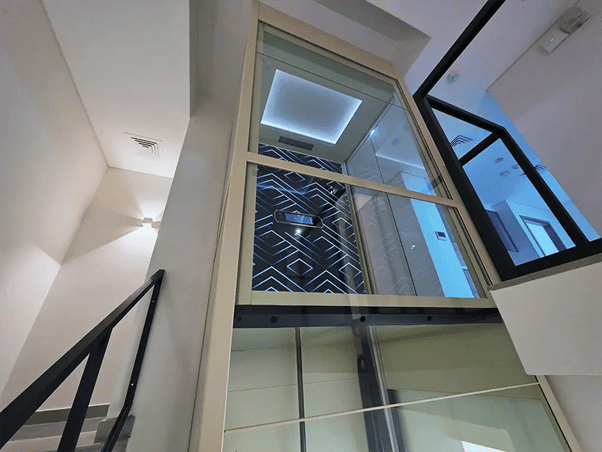
For Cibes lifts, site preparation is often lighter than many conventional elevator systems. This is because Cibes lifts use a modular shaft and do not require a separate machine room.
In many projects, Cibes platform lifts need a shallow pit of around 50 mm, while Cibes cabin lifts may need around 100 mm, depending on the model and site condition.
For deeper planning, homeowners can refer to the Cibes guide on home lift installation in the UAE.
What factors affect home lift installation time?
Several factors can make the installation faster or longer. In most UAE homes, the lift itself is only one part of the timeline.
How many stops will the lift serve?
The number of stops is one of the biggest timeline factors.
A 2-stop lift is usually the fastest because it connects only two levels, such as ground floor to first floor. A 3-stop lift needs more shaft height, more landing door work, and more testing. A 4-stop lift or higher needs extra time for alignment, wiring, door installation, and commissioning across several floors.
This is why a G+1 villa usually has a shorter installation timeline than a larger G+3 villa or a home with basement, ground, first floor, and roof access.
Is the site ready before materials arrive?
A ready site allows the installation team to start immediately.
A site is usually ready when:
- The lift area is clear
- The pit or recess is complete
- Floor openings are finished
- Electrical supply is available
- Floor levels are confirmed
- Access routes are clear
- Approvals are in place, if required
- Other contractors are not blocking the work area
If the lift materials arrive before the site is ready, the installation timeline may pause before it even starts.
Is the lift for a new villa or an existing home?
New villas are usually easier to plan because the lift location can be included early in the design. The contractor can prepare the opening, pit, electrical point, and finishing before the lift arrives.
Existing villas can also be suitable for home lifts, but the timeline depends on the structure. The survey may need to check slab thickness, beams, staircase voids, wall positions, and available space.
For retrofit projects, Cibes lifts are often placed in stairwell voids, indoor corners, external walls, balcony areas, or through-floor openings.
A helpful supporting guide is the Cibes article on space-saving home lifts in the UAE, which explains how compact lifts can fit existing homes.
Is the lift indoor or outdoor?
Indoor lifts are usually faster when the area is ready and easy to access.
Outdoor lifts may need more site preparation. This can include drainage, waterproofing, door canopies, weather-resistant finishing, foundation work, and protection for electrical components.
Outdoor home lifts are common in UAE villas where the lift connects the garden, parking area, majlis entrance, balcony, terrace, or roof. They are practical, but they need proper planning because of heat, dust, humidity, and occasional rain.
Is the home a villa, townhouse, duplex apartment, or penthouse?
The property type affects access and coordination.
Villas usually offer more flexibility. There may be several possible lift locations, such as beside a staircase, in a corner, through a slab opening, or outside the villa.
Townhouses often have tighter space. The lift location must be planned carefully so it does not block doors, corridors, parking, or daily movement.
Duplex apartments and penthouses need more coordination with building management. Lift parts may need to pass through service elevators, loading bays, corridors, and common areas.
This is where modular lift systems help. Cibes lifts are delivered in parts and assembled on site, which makes them practical for villas, duplexes, and penthouses where large lift components may be difficult to bring in.
Are approvals required before installation?
Approval requirements depend on the emirate, property type, community, and scope of work.
In Dubai, the Dubai Building Code is an important reference for building design and construction requirements. Accessibility may also be relevant, especially for People of Determination, elderly users, or wheelchair users. The Dubai Universal Design Code provides local accessibility guidance.
For platform lifts, EN 81-41 is a key European standard for vertical lifting platforms intended for persons with impaired mobility. The EU Machinery Directive 2006/42/EC is also relevant for machinery safety.
These references help explain why proper survey, installation, testing, and handover are important. They do not replace local project approval. Homeowners should confirm the approval path with their consultant, contractor, community developer, or local authority.
How does Cibes reduce installation disruption?
Cibes lifts are designed as modular, space-saving home lift systems. The lift comes with its own shaft structure and is assembled at site. The drive system is integrated, so there is no need for a separate machine room.
This can reduce civil work compared with many traditional lift systems.
Cibes screw-driven lifts are especially suitable for UAE homes where space is limited or where the home was not originally designed with a lift shaft. The technology is commonly used for low-rise residential travel, including villas, townhouses, and duplex homes.
The Cibes guide to screw-driven home lifts explains how the system works and why it is suitable for compact residential lift installations.
For homeowners comparing lift types, the guide on platform lift solutions for homes in the UAE also explains when a platform lift may be suitable, especially for wheelchair access and flexible door configurations.
Do all home lifts take the same time to install?
No. Not all home lifts have the same installation time, even when they serve the same number of floors.
Two lifts may both be 2-stop lifts with the same travel height, but one can still be easier to install than the other. The difference usually comes from the lift type, shaft design, platform or cabin size, door configuration, and how much layout flexibility is required.
For example, Ascenda is often easier to install than a Cibes V80 when both are planned for the same 2 stops and the same travel height. Ascenda is designed for simple two-floor access, so the installation can be more straightforward when the site is ready and the layout is not complex.
Cibes V80, on the other hand, is a platform lift with more layout flexibility. It can support different platform sizes, wheelchair access needs, and more door access configurations. This makes it more adaptable for different homes, but it may also require more planning during installation.
| Comparison point | Simpler 2-stop lift such as Ascenda | Flexible platform lift such as Cibes V80 |
| Typical use | Simple two-floor access | Flexible access for different users and layouts |
| Installation complexity | Usually easier | May need more planning |
| Best fit | Compact homes with straightforward movement | Wheelchair access, larger platform needs, or flexible door access |
| Site coordination | Often simpler | Can involve more layout and access coordination |
| Main advantage | Simple and efficient 2-stop installation | More flexibility for comfort, accessibility, and design |
This is why installation time should not be judged only by the number of stops. A 2-stop home lift can be simple or more detailed depending on the model, access direction, platform size, and site condition.
What are the typical Cibes installation timelines by number of stops?
How long does a 2-stop Cibes home lift take?
A 2-stop Cibes home lift usually takes 5 to 10 days to install after materials arrive on site.
This is common for:
- G+1 villas
- Duplex apartments
- Townhouses
- Ground to roof access with only two landing points
The timeline is usually shorter when the site is ready, the lift position is clear, and there are no major structural changes still in progress.
How long does a 3-stop Cibes home lift take?
A 3-stop Cibes home lift usually takes 8 to 15 days to install after materials arrive on site.
This may apply to:
- G+2 villas
- Basement plus ground plus first floor
- Ground plus first floor plus roof
- Larger duplex or triplex homes
The extra stop adds more shaft height, more door installation work, more electrical coordination, and more testing.
How long does a 4-stop Cibes home lift take?
A 4-stop Cibes home lift usually takes 12 to 20 days after materials arrive on site.
This is common for larger villas or private homes with several living levels. The installation team needs more time for shaft alignment, door setup at each level, electrical work, safety checks, and commissioning.
How long does a 5-stop or 6-stop Cibes home lift take?
A 5-stop or higher Cibes lift usually takes 15 days or more after materials arrive on site.
The final schedule depends on travel height, number of landing doors, lift model, site access, finishes, and whether the lift is installed indoors or outdoors.
What happens during the actual home lift installation?
The process may vary by model, but most home lift installations follow a clear sequence.
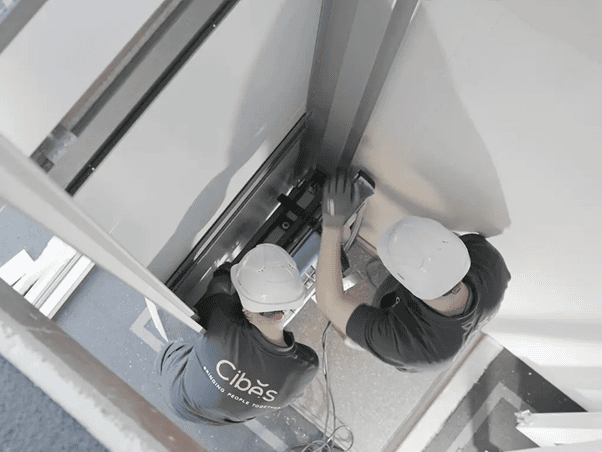
First, the installation team checks the lift location, floor levels, dimensions, and access route. Then the lift components are moved into the property.
The shaft is assembled section by section. After that, the drive system, platform or cabin, landing doors, control panel, electrical wiring, and safety systems are installed.
Once the lift is assembled, the team tests the lift. Testing usually includes travel between floors, door operation, landing accuracy, emergency functions, overload protection, safety sensors, and user controls.
The final step is handover. The homeowner receives basic operating guidance, safety instructions, and service information.
How can homeowners shorten the installation timeline?
The best way to shorten the installation timeline is to prepare the site before the lift arrives.
Homeowners can help by confirming the lift location early, preparing the electrical supply, clearing the access route, finishing the pit or recess, and completing any slab cutting before delivery.
It also helps to decide the lift model, size, door direction, colour, glass type, and flooring early. Late changes can affect production and project coordination.
What should you ask before confirming a home lift installation?
Before confirming a home lift supplier in the UAE, ask clear questions about the timeline.
Good questions include:
- Does the installation timeline start after materials arrive on site?
- Does the timeline include testing and handover?
- What site preparation is excluded?
- Is a shallow pit required?
- Is a machine room required?
- Who checks the structural opening?
- Who prepares the electrical supply?
- Who handles building management or authority coordination?
- What happens if the site is not ready when materials arrive?
These questions help avoid misunderstanding, delays, and unexpected extra work.
Frequently Asked Questions (FAQs) about Home Lift Installation Time in the UAE
How long does it take to install a home lift in the UAE?
A home lift usually takes 5 to 20+ days to install after materials arrive on site. The final timeline depends on the number of stops, lift model, site readiness, and whether the lift is installed indoors or outdoors.
How long does a 2-stop home lift take to install?
A 2-stop home lift usually takes 5 to 10 days to install after materials arrive and the site is ready. This is common for G+1 villas, townhouses, and duplex apartments.
How long does a 3-stop home lift take to install?
A 3-stop home lift usually takes 8 to 15 days. The extra stop adds more shaft height, landing door work, electrical coordination, and safety testing.
How long does a 4-stop home lift take to install?
A 4-stop home lift usually takes 12 to 20 days after the materials arrive on site. Larger homes need more time for alignment, door installation, testing, and commissioning.
How long does a 5-stop home lift take to install?
A 5-stop home lift usually takes 15 days or more. The final timeline depends on travel height, model, access, site readiness, and finishing requirements.
Does home lift installation time include civil work?
No. Installation time usually does not include civil work or site preparation. Slab cutting, pit preparation, electrical work, finishing, and approvals should be planned separately.
Is Ascenda faster to install than Cibes V80?
In many simple 2-stop projects, Ascenda can be easier to install than Cibes V80 when both have the same travel height. Ascenda is usually simpler for straightforward two-floor access, while Cibes V80 gives more flexibility for platform size, wheelchair access, and door configuration.
Do Cibes lifts need a deep pit?
No. Cibes lifts are designed with shallow pit requirements. Platform lifts usually need around 50 mm, while cabin lifts may need around 100 mm, depending on the model and site condition.


Final thoughts
Most UAE home lift installations are quicker when the site is ready before the lift materials arrive.
A 2-stop home lift may take 5 to 10 days. A 3-stop lift usually takes 8 to 15 days. A 4-stop lift may take 12 to 20 days. A 5-stop lift or higher usually needs 15 days or more.
The full project timeline is different from the installation timeline. Survey, approvals, production, delivery, and site preparation all happen before the installation starts.
Cibes lifts are designed to make this process easier for villas, townhouses, duplex apartments, and penthouses in the UAE. With a modular shaft, shallow pit requirement, and no separate machine room, they can often be installed with less structural disruption than many conventional elevator systems.