
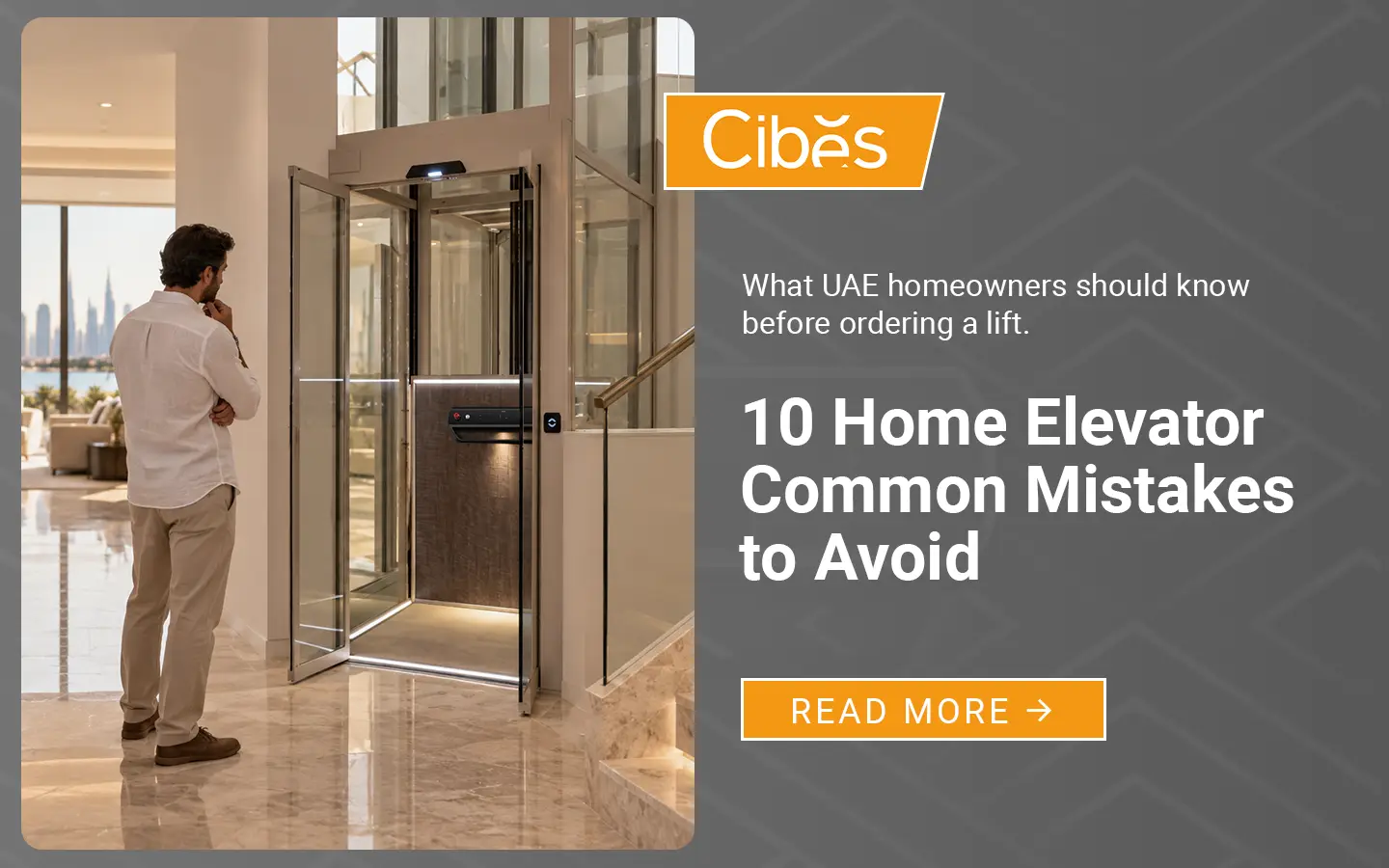
TL;DR The most expensive home elevator mistakes often start before installation. Choosing the wrong size, drive system or supplier can affect accessibility, building work and long-term reliability. In UAE villas, homeowners should also pay attention to finished-floor levels, approvals, outdoor heat and the availability of local maintenance support.
Buying a home elevator is a major decision. Unlike furniture or appliances, a lift becomes part of your home’s structure. Once installed, changing its dimensions, position or drive system can involve significant building work.
At Cibes Lift UAE, we work with homeowners, architects and contractors on both newly built and existing villas. One thing is clear from our experience: a lift that looks suitable on a drawing may not be the right lift for the people who will use it.
Some mistakes affect comfort. Others can limit accessibility, increase costs or create service problems years later.
Here are ten mistakes worth understanding before you order a home elevator.
Why Can a Home Elevator Fit Your Villa but Still Be the Wrong Size?
Mistake 1: Choosing the smallest available lift without considering who will use it
Saving space is important, especially when adding a lift to an existing villa. But choosing the smallest available lift is not always the right decision.
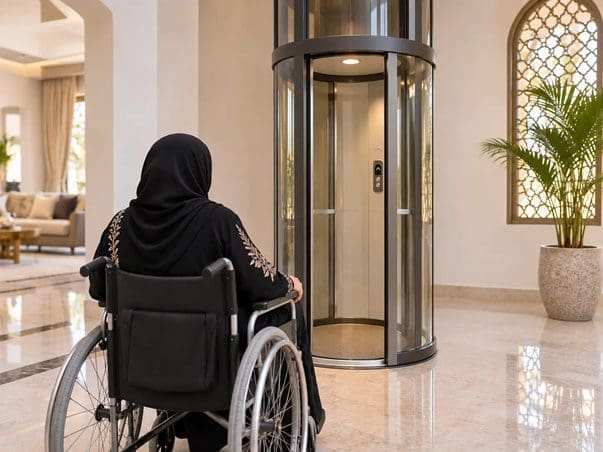
A lift may comfortably carry one or two standing passengers yet be unsuitable for a person using a wheelchair or other mobility equipment.
We’ve seen why this matters in an existing villa in Emirates Hills, Dubai.
The homeowner already had a conventional traction lift installed inside a shaft. However, the cabin was too small to accommodate their wheelchair.
The issue wasn’t that the property lacked an elevator. The existing elevator could not meet the homeowner’s accessibility needs.
A larger Cibes Air platform lift was installed to provide the required access.
It’s a useful lesson: the number of passengers or rated load doesn’t tell you whether a wheelchair will fit.
The Dubai Universal Design Code specifies 900 × 1,500 mm of clear platform space for the vertical lifting platforms covered by its provisions.
That is a useful reference when assessing accessibility, although the requirements that apply to a particular private villa must be confirmed separately.
Before choosing the size, consider the actual user, their mobility equipment, the usable internal dimensions and the clear door opening.
For a more detailed explanation, see our guide to the 41 Cibes home lift sizes.
Mistake 2: Measuring the shaft but ignoring the space outside the lift
A home elevator doesn’t function in isolation. People need space to approach, enter and exit it.
This is particularly important when installing a lift inside a staircase opening or an existing villa where the surrounding space is already fixed.
A technically suitable shaft may still have an awkward entrance.
For example, the landing door could interfere with a nearby staircase, furniture, hallway or another door. A wheelchair user might have enough room inside the lift but insufficient space to approach it safely.
The Dubai Universal Design Code also identifies a 1,500 × 1,500 mm obstacle-free landing area for applicable vertical lift platforms.
That does not mean every private residential lift needs this exact arrangement. It shows why the surrounding space deserves as much attention as the lift dimensions.
From our perspective, a home lift should be assessed as part of the room, not simply as equipment that fits inside an opening.
What Happens When Homeowners Choose the Wrong Lift Technology?
Mistake 3: Choosing a drive system based only on speed or price
Not all residential elevators use the same lifting mechanism.
Screw-driven, traction and hydraulic systems move the lift differently. Those differences affect space requirements, rated speed, building work and maintenance.
A homeowner might choose a conventional traction elevator because it offers a higher speed, without considering whether the extra performance is necessary for a two-storey villa.
Another might choose a compact, low-speed lift for a larger property where travel height, frequency of use or journey time makes a different system more practical.
For context, EN 81-41:2024 covers a defined category of vertical lifting platforms with a maximum rated speed of 0.15 m/s.
At that speed, travelling 3 metres takes 20 seconds in a simplified constant-speed calculation. An actual journey also involves acceleration, stopping and door operations.
A higher-speed lift can reduce travel time. But it should not be compared without considering the complete installation requirements.
We manufacture screw-driven home lifts because this technology offers useful advantages for compact, low-rise residential installations. However, there are applications where a conventional lift is more appropriate.
Our article on traction, hydraulic and screw-driven home lifts explains the differences in more detail.
Mistake 4: Assuming every home lift follows the same safety standard
A supplier may advertise a lift as meeting European safety standards without explaining which standard applies.
That distinction matters.
For example, EN 81-41:2024 covers a specific category of vertical lifting platforms intended for persons with impaired mobility, including wheelchair users.
It is not a universal standard covering every type of home elevator.
Different lift categories can have different construction and safety requirements.
When reviewing a product, don’t rely on a general statement that it is certified.
Ask which standards apply to that exact model and what documentation supports the claim.
A declaration of conformity, relevant certificates and the manufacturer’s technical documentation provide more useful evidence than a general safety claim.
Which Home Elevator Installation Mistakes Are Difficult to Correct?
Mistake 5: Building the elevator pit before confirming the lift requirements
In newly built UAE villas, the architect or contractor may reserve an elevator shaft and construct the pit long before the homeowner selects the actual lift.
This can create problems.
Different elevator technologies require different pit depths. Even lifts using the same drive system can have different requirements.
For example, selected Cibes platform lifts require approximately 50 mm of pit depth and may be installed without a pit using an access ramp.
Selected Cibes cabin models typically require a shallow pit of around 100 to 120 mm, depending on the configuration.
These are not universal home elevator dimensions.
One particularly important detail is the finished-floor level.
A pit measured from the structural concrete slab may not have the correct depth once marble, tiles, screed or other floor finishes are installed.
If the completed pit doesn’t match the approved lift drawing, the contractor may need to modify the floor or make additional corrections.
This is why we recommend confirming the exact model and its approved technical drawings before completing the pit.
Our article on home elevator pit design and requirements in the UAE explains the technical considerations.
Mistake 6: Assuming every villa modification can proceed without approval
Home lift installations can involve more than placing equipment inside a room.
Depending on the location, a project may require cutting an existing floor opening, altering a staircase, adding an external lift enclosure or making structural changes.
The approval requirements depend on the property and the authority responsible for the site.
Dubai Municipality provides a process for building modifications and additions. In areas under Dubai Development Authority, its building modification permit service applies to relevant changes to completed buildings.
Abu Dhabi also introduced a simplified approval process for certain minor residential works in August 2025. The changes cover specified work on villas and other residential properties, but do not mean every home lift installation automatically qualifies.
Homeowners in managed villa communities, townhouses and penthouses may also need to coordinate with the developer, owners’ association or building management.
The mistake is assuming these matters can be settled after the lift has already been ordered.
Why Can a Lower Home Elevator Quotation Become More Expensive?
Mistake 7: Comparing lift prices without checking what is included
Two home elevators with similar dimensions and appearances can have very different quotations.
Sometimes the difference comes from the technology, materials, safety equipment or country of manufacture.
In other cases, the quotations simply cover different scopes of work.
One supplier may include the lift, enclosure, delivery, installation, testing and handover.
Another may quote only part of the project, leaving certain civil works, electrical connections or finishing work to others.
Neither approach is necessarily wrong. The problem begins when the homeowner assumes both quotations cover the same work.
For example, an attractive lift price may not account for the cost of constructing a shaft or altering the surrounding floor.
Those additional costs can change the final project budget.
The correct comparison is the total installed cost, with clear responsibilities for equipment, building work, commissioning and handover.
Our home lift price guide for the UAE explains how different specifications affect the overall cost.
Mistake 8: Choosing a supplier without checking long-term service support
A home elevator is not a one-time purchase.
It contains mechanical, electrical and electronic components that require maintenance. Some parts will eventually need replacement.
A supplier’s installation experience is important, but so is its ability to support the lift years after installation.
This is particularly relevant when products are imported into the UAE.
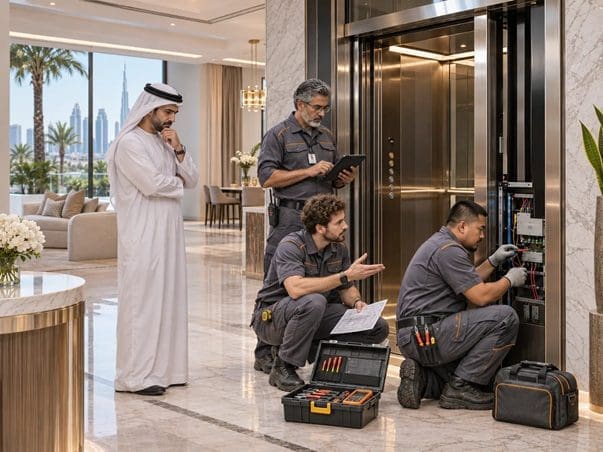
Before signing a contract, it is worth understanding who will carry out future maintenance, where spare parts will come from and who is responsible for technical support.
A warranty is useful, but it should not be confused with a complete maintenance agreement.
The contract should explain what the warranty covers, which service visits are included and what happens when a component needs replacement.
For reference, Cibes Lift UAE’s Annual Maintenance Contract typically costs AED 3,500 to AED 4,500 per year after the complimentary maintenance period, depending on the lift and site.
Our UAE maintenance programme includes four scheduled preventive visits per year.
These are Cibes-specific figures, not average prices or maintenance requirements for every home elevator brand.
You can read more in our home lift maintenance cost guide.
Which Mistakes Are Especially Relevant to UAE Homes?
Mistake 9: Treating an outdoor lift like an indoor installation
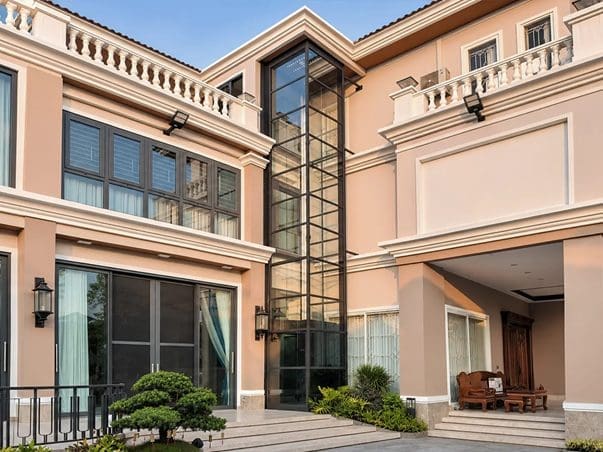
Outdoor home lifts can be practical for villas where indoor space is limited.
But moving the lift outside introduces conditions that indoor installations may not face.
In the UAE, direct sunlight, extreme heat, humidity and dust can affect the lift’s environment and its components.
A panoramic glass lift positioned against a sun-facing exterior wall may experience significantly different conditions from the same lift installed inside an air-conditioned house.
Weather protection alone does not solve every problem.
The lift’s operating-temperature limits, electrical enclosure, ventilation, doors, glazing and exposure to sunlight must be considered together.
Interestingly, EN 81-41:2024 does not specify additional requirements for operation in severe conditions such as extreme climates.
That makes the manufacturer’s actual environmental specifications important.
At Cibes Lift UAE, our outdoor projects require an assessment of the installation environment. Depending on the site and model, the design may need measures such as shading, ventilation, suitable glazing or additional temperature control.
Our outdoor home lift installation guide explains these considerations.
Mistake 10: Overlooking emergency operation and extended periods without use
Power failures may not be the first thing a homeowner thinks about when choosing an elevator.
But the emergency operation system deserves attention.
A residential lift should have suitable arrangements for dealing with a power interruption and for contacting or assisting a passenger when necessary.
Cibes home lifts incorporate emergency provisions, including battery-supported rescue functions on applicable models. The precise operation depends on the lift configuration.
During our technical support and maintenance work in the UAE, battery condition is one area that deserves regular attention.
This matters particularly in outdoor installations exposed to heat.
There is also a local ownership consideration that can easily be missed: villas left unoccupied for extended periods.
If the lift’s electrical supply is disconnected for a long time, its backup batteries may become discharged.
Homeowners should understand the manufacturer’s instructions for periods when the property will be vacant, rather than simply switching off the equipment without checking.
Frequently Asked Questions (FAQs) About Home Elevator Mistakes?
Can a home elevator be too small for a wheelchair?
Yes. A lift may have enough capacity to carry a wheelchair user but insufficient internal space or door clearance to accommodate the wheelchair safely. Always check the actual dimensions and user’s mobility equipment.
Is it a mistake to build the elevator shaft before choosing a lift?
Not necessarily. A shaft can be planned during early construction, but its final dimensions, pit and headroom should be coordinated with the selected lift. Otherwise, alterations may be required.
Does every home elevator need a deep pit?
No. Pit requirements vary by technology and model. Some compact home lifts can use a very shallow pit, while selected platform lifts can be installed directly on the finished floor with a ramp.
Is a cheaper home elevator necessarily lower quality?
No. A lower price may reflect simpler finishes, smaller dimensions or a different equipment scope. Product quality, safety documentation, installation inclusions, service support and long-term costs should be considered separately.
Can I install an indoor home elevator outside my UAE villa?
You should not assume an indoor model is suitable outdoors. The manufacturer must confirm its environmental limits and the required protection against heat, water, dust and sunlight.
What is one of the hardest home elevator mistakes to correct later?
Choosing a lift that cannot meet its intended use can be particularly difficult to correct. Increasing the usable cabin size or changing the entrance arrangement after installation may require significant modification or replacement.
What Should You Remember Before Ordering a Home Elevator?
The biggest home elevator mistakes rarely begin with the appearance of the lift.
They begin with overlooked dimensions, incorrect building assumptions, unsuitable equipment specifications or unclear long-term responsibilities.
A lift is meant to serve your home for many years. Its practical suitability matters as much as its design.
As a Swedish home lift manufacturer with direct operations in the UAE, we believe homeowners deserve clear technical information before making that decision.
For broader information about residential lift types, costs, installation and ownership, read our UAE Homeowner’s Guide to Home Lifts.


